Time Quintet Re-read: An Acceptable Time

Well, Squiders, here we are at the end of our re-read. I hope you’ve had a good time of it, and stay tuned for our next one, to be announced some time in the next few weeks. And it you hadn’t read the Time Quintet yet, I hope you enjoyed the books.

To be perfectly honest, I thought there were only four books in the series, but I did a Google search in the process of posting about the re-read and lo! there were five books.

I admit I don’t read much L’Engle outside of these books. I read A Ring of Endless Light last year and I didn’t really like it, so I think it’s the combination of science and religion that I like. She does it somewhat masterfully, really. To paraphrase something Bishop Colubra says in this book, it doesn’t matter if you believe in God, but he does, and that’s okay. Characters are religious or not, nephilim and cherubim exist, “El” talks to Noah, but none of it is in your face.

All right, onto An Acceptable Time. Maybe it’s just me, but I feel like characterization isn’t really one of L’Engle’s strong points. All of her main and peripheral characters are essentially good-hearted people who do the right thing, whether or not they are a native person from three thousand years ago or a modern person. I’m not sure, if you took Polly out and replaced her with Meg, that you’d see any real difference in the story.

Zachary’s an ass. He was one in A Ring of Endless Light too.

Let’s see. It’s nice to see some continuity between this and Planet, with the People of the Wind, though there is no mention of dark planets or IT or anything of that nature. (And now that we’ve gotten all the way through without returning to IT at all, I’m a little disappointed. Maybe if she’d tied IT to the events in A Wind in the Door a bit, I’d be less annoyed.) And the part in the past, if you ignore the ability of all the characters to learn languages rather quickly, is interesting.

I did have a bit of an issue with the “modern” day part, however — specifically how disbelieving the Murrys are about the whole idea of time-travel. They were there for A Wrinkle in Time and A Wind in the Door. They know things like this happen, even if they’re completely unaware of the events of Many Waters  and A Swiftly Tilting Planet. I’m not sure why so many characters are suddenly so closed-minded.

(Also, did something happen to Charles Wallace? Polly mentions that he “would have liked” the changes to his bedroom early in the book, and then he’s not mentioned again, hardly, though Meg, Calvin, Sandy, and Dennys are.)

All right, onto the discussion questions. As always, feel free to ask your own in the comments.

1. Madeleine L’Engle is sometimes accused of being culturally insensitive when it comes to the People of the Wind. Would you say that this is true when it comes to this book?

2. Polly is staying with her grandparents to be homeschooled, but Charles Wallace and Meg were not allowed to be homeschooled earlier in the series. Why do you think attitudes towards this have changed throughout the series?

3. While most of the “modern” day characters have been seen in other books, why do you think Madeleine L’Engle chose to include the character of Bishop Colubra?

4. Time travel throughout the series is rarely set up so that the time traveler returns to his/her own time without some noticeable passage of time (the only exception being Sandy and Dennys in Many Waters). Why is it important for time to pass in both times?

5. Many of the characters in the past have nature based names such as Cub, Eagle Woman, Winter Frost, Dark Swallow, yet the main characters do not. Why the difference in the naming scheme?
Holiday Complications

Last week, I talked about how it seems so much harder to get into the holiday spirit now that I’m an adult over at Turtleduck Press. But I’ve been thinking about it, and I think I’ve figured it out.

Everything’s so complicated now.

When I was a kid, my sister and I had our routine. We’d watch every tapped Christmas special we could find (A Muppet Family Christmas was always my favorite), crawl into bed together, and then get up whenever we woke up, open our stockings, and wait for our parents to get up.

Then we’d do presents, Church, and spend the afternoon and evening at our grandparents, playing with our cousins and eating too much.

It was simple, fun.

I think it started to change when my husband and I got serious and starting bringing each other home for Christmas. Our parents are both divorced, so instead of each of us managing two, we suddenly needed to do four. And, of course, they all overlapped.

And then our siblings got married, which also limited available times, and so on…

So now, I think, instead of being able to enjoy the holidays as a family, we get so stressed about trying to squeeze in all sorts of different family gatherings.

It’s truly ridiculous. Something has got to change. We have a child now, and in a year or so we’re going to need to start putting our family unit first.

Squiders, how have you dealt with managing the holidays when you’ve got both sets of parents (or multiple sets of parents, in the case of divorce) local? Anything tips for lowering the stress or dealing with hosts’ hurt feelings if you can’t make it?

The Evolution of an Idea

Anthologies are always interesting. First you’ve got to come up with a theme for the overall anthology, and then you’ve got to come up with a story that fits for it.

When we started brainstorming for Seasons Eternal, we had a bit of a hard time coming up with a theme idea. We’d done winter-themed for last year’s Winter’s Night, so we didn’t want to repeat that, but we weren’t sure where to go. Did we want to pick a genre? And not just something like, say, steampunk, because everyone else does that sort of thing. Steampunk with strong heroines! Steampunk with strong heroines who happen to be airship pirates!

It was actually my husband who came up with the premise that would become Seasons Eternal, the world where the seasons had stopped. I think it appealed to us because it would be a shared world, so our stories could be more interconnected than just four people trying to tell stories that may or may not be anything like each other.

So, theme picked, we assigned seasons. The way scheduling worked out, I was assigned spring a little later than everyone else, and, hence, got to work after everyone else, so I went into my story having a sense of what everyone else was doing in theirs.

At first, I was stumped. I don’t know if any of you live on the west coast, but that’s pretty much how I picture an eternal spring. It never really gets cold or hot, there’s not a lot of inclement weather you need to worry about, and you can grow things year-round. Let’s face it–if the seasons were going to stop, Spring would be the one you’d want to get stuck in. (In fact, my biggest complaint about the weather when we lived in California was that there were no seasons and it made it hard to mark the passage of time in my head.)

(Californians will tell you that there are two seasons: wet and dry. To that I say: Bah!)

(Oh man, candy cane and cocoa taste terrible together.)

As Siri says, stories are about people. And unlike a summer where the heat never ends, or a winter where the snow never stops, Spring doesn’t really bring any hardship to the people. In fact, they probably felt like they’d been blessed, where everyone else had been cursed. Like they had been deserving, like they had been…justified.

And they wouldn’t want to share their good fortune.

I don’t think I can say more without giving the story away. Seasons Eternal: Stories of a World Frozen in Time is available through Turtleduck Press at your favorite e-retailer. (Just a reminder that proceeds from sales goes to UNICEF to make children’s holidays more joyful and bright!)

Loving a Book in a Genre You Hate

I do not like historical fiction. It is my very least favorite genre. Not sure why–maybe I feel that the authors tend to force morals or ideas on the reader that are out of touch with the time period? Or I just simply don’t care. Or something. Either way, I tend to steer clear for my own sanity.

(Not to say that there are not the occasional ones that I enjoy quite a bit. I’ve read most of Tracy Chevalier’s stuff. Though I admittedly started with one that switched between modern day and a past time, which is one of my very favorite writing conventions.)

(I also want to point out that this is only a problem with modern authors writing past times. Stories written hundreds of years ago about times that are contemporary to them are fine, for obvious reasons.)

So it was to my very great surprise that I enjoy the Horatio Hornblower series quite as much as I do. I told myself that I was doing it for research–I wanted to set a story on a ship, and I know very little about them. (Ships have…masts! And sails!) Also, my husband was reading the first book and wanted to discuss it, and I occasionally indulge him.

But I love the books, I really do. We’re admittedly going chronological, rather than the order C.S. Forester wrote them in, so we started somewhere in the middle of his career, but I love everything about them.

His descriptions are spot-on. I honestly thought, at first, that he was contemporary to the time period (later 1700s to early 1800s) because everything was so perfect that it felt like it was someone who was intimately familiar with how things worked on a ship of the line. (C.S> Forester wrote from the mid 1930s to the 1970s or so.)

To be honest, it kind of reminds me of some of the science fiction I like, except, you know, being about the British navy during the Napoleanic wars.

My biggest complaint is that my husband is such a slow reader that I’m not getting through them as fast as I’d like.

What about you, Squiders? Do you have a book or series that you adore that is in a genre you normally can’t stand? (Just want to chat about Hornblower? Also welcome!)

Warning: Duotrope Going Subscription

A few times over the years I’ve mentioned Duotrope as a good resource for those of us who write and submit short stories as they list markets and allow you to keep track of who you’ve submitted to, and what their responses were.

Duotrope has always been a donate if you can service, but starting on January 1st, they’re moving to a subscription model. They’re asking for $50/year, or $5/month.

If you can afford it and are willing to, go ahead and continue supporting them. However, one of the biggest complaints I’ve heard about this move is that the submission stats, which they list on each market’s page, are going to become skewed as many users stop using the site. If you use these stats, then keep this in mind. (I don’t.)

If you are using Duotrope currently, you may want to back up your information in case you lose access to it when they go to the new model. More information on the changes can be found here.

Here are some alternatives if you don’t want to pay the subscription price (which, to be honest, is a bit steep for the service they provide, IMHO. I’d pay $10, $15, maybe $20 a year).

Microsoft Excel (or, alternatively, Google Drive’s spreadsheet function) can be used to track submissions.

Ralan.com tracks markets if you write speculative fiction.

The Black Hole at critters.org also keeps track of speculative fiction markets.

The forums at Absolute Write often keep track of new markets and anthologies that are currently looking for material, as well as many other useful things.

If you know of any other services that provide similar things, especially websites that keep track of non-speculative fiction markets, please share the wealth, Squiders.

Following Authors Across Genre

I was, for some reason, thinking about J.K. Rowling this morning, and wondering if she’s disappointed in the sales for her latest book, The Casual Vacancy. Sales for it have been decent, more than decent, really, but 120,000 copies in your first week when your last book sold 2.6 million copies its first week is quite the difference.

I haven’t read it; I probably never will. Its plotline and genre do not appeal to me, so even though I enjoyed the Harry Potter series rather a lot (as you can see by reading the re-read posts and various other Potter-related bits that have popped up here on the blog over the years) and think she’s an excellent author, exceptionally skilled, especially in foreshadowing and characterization, she’s lost me as a reader on this particular book.

This reminded me of a conversation we had on my writing forum a while ago, about whether or not you’d follow an author across genres. Like, say, your favorite fantasy author starts writing political intrigue set in rural England.

The answer seems to be…maybe, but it depends.

Most people pick what to read based off genre. They read mostly romance, or science fiction, or mystery. There’s elements of the genre that appeal to that person, and they stick to what they like. Reading is supposed to be fun, after all. Sure, occasionally people will pick something up that’s out of their comfort range for whatever reason, but that doesn’t tend to be the bulk of their reading.

If someone especially likes an author’s work, it seems like a reader will follow them to related genres, but if the author strays too far, the reader will normally stop following them after a while. In my own personal experience, the works of Jennifer Crusie have done this. I love Jenny; I think she’s witty and brilliant and I would like to grow up to be her. She writes primarily romance, with some romantic thrillers or paranormal romance thrown in. Lovely. But in early 2010, she and Bob Mayer (who had collaborated together before, and I really adore Agnes and the Hitman) put out a straight thriller, and as much as I love them, I wouldn’t follow them there. They’d gone too far.

Asimov wrote fantasy too, but no one really ever talks about it.

What do you think, Squiders? Would you follow your favorite author no matter where they went, or is there a point where you think you would stop? Have you stopped? What was the line that could not be crossed?

Announcing Seasons Eternal

Hey Squiders, do you have friends or family (or yourself) that enjoy science fantasy? Do you need Christmas (or other holiday) present ideas? Then look no further!

The incredibly sexy ladies over at Turtleduck Press (myself included) have just put out their second anthology, and we decided to work from a shared world concept this year. Our going idea was: what would happen on a world where the seasons had stopped changing, locking entire regions into one of the four? How would society have to adapt to continue to survive, say, if summer’s heat never waned, if autumn never finished its decay?

We set up ourselves up with some vague parameters: the seasons would have stopped changing about a hundred years previously, only a few generations back, so that society could still be in a state of flux, but enough time had passed that they would have figured out enough to continue surviving. And then we went to it.

The result is an interesting mix, as each author had to imagine what a season that never ended would look like, what it would do to the land, the animals, the people, and then come up with society’s response. Would they turn to technology? Would they run from it? Would stories of the seasons make it into legend, or would they be forgotten?

Could it be fixed? Would they try?

As with our last anthology, the proceeds from sales go to benefit UNICEF, hopefully making children around world’s holidays a little brighter. Ebooks are available for 99 cents, and the paperback is available for $4.99. Cheap and for a good cause! Oh, and full of science fantasy goodness. More information can be found here, so give it a look!

Time Quintet Re-read: A Swiftly Tilting Planet

I want to begin by saying that I have a paperback copy from 1981, and Charles Wallace has an epically bad late-70s/early-80s haircut on the cover.

Let’s see. Having read this now, I don’t think I’ve read it before. I can remember, probably at least a decade ago, searching through used book stores and rummage sales in search of A Swiftly Tilting Planet because I had the other three books and not this one, but apparently I never actually read the book once I finally acquired it. Go me.

I did like it, though. I thought it made a good continuation from A Wind in the Door with the Echthroi and the upping of the stakes (though I continue to be uncertain how IT and dark planets connect, and there’s no mention of either in this book). I liked how small changes throughout history–even just in a few families’ lines–can turn a potential bad event into a good one.

There were some things I found infuriating, however. Whenever Charles Wallace was Within, he essentially disappeared. We know, from the narration, that his being Within changed something in the time, just a little, to get a more positive outcome over a negative one, to swing the balance, but you have no idea what it was. For example, in the colonial period, where Zylle was being tried as a witch, I assume in the original time line she was burned and so forth, but I couldn’t tell you why it went differently with Charles Wallace. After being Within Madoc, Charles Wallace asks if he gave Madoc the rune, but this wouldn’t have been true in later times because the rune was passed down through the families. So I would have liked just a hint of what changed with Charles Wallace there, what he brought into the equation that hadn’t been there before.

And with most of the times, I could guess at what had changed, but the one with Beezie and Chuck…I have no idea. Sometimes it seemed like most of the point of being there was to get bits of the story, leading up to the final Within, the one that directly determined whether it would be a good or bad future, the one with Matthew Maddox, but then, it was a bit of a false lead-up, because we didn’t get any more insight into what Charles Wallace did to help there than we did elsewhere.

I can see why she went back and set Many Waters  between this and A Wind in the Door. It’s been nine years, and you have to wonder what happened in that time period, why, after two encounters with dark forces in two years, that they’d gone so long without another.

On the other hand, you have unicorns in both this book and Many Waters, and they don’t quite work the same. Gaudior is an intelligent being, who can talk and think and so forth. While the unicorns in Many Waters can also travel through space and time, they don’t seem to be intelligent at all, and don’t really exist when they’re not there. I’m not sure why she chose to have unicorns in both but not be consistent with them.

Sandy and Dennys seem a bit out of character here if you take the events of Many Waters into account. Which is always a risk in backtracking your characters.

Calvin continues to not really be much help.

Questions!

1. Madeleine L’Engle has always been a bit vague about when and where the Time Quintet takes place, sometimes leaving contradictory clues. Based on this book alone, what would you say the when and where is?

2. Is it right for Charles Wallace to push people towards decisions that they would not have made on their own? Why or why not?

3. What is gained by having Meg kythe along for the journey?

4. What do you think the title means?

5. Why do you think it’s necessary to have time pass in the present while Charles Wallace and Gaudior are off riding the wind through time?

As always, your own questions and comments are welcome. And we’ll read our final book, An Acceptable Time, for December 27th.

Of Sulking Alpacas and Scones

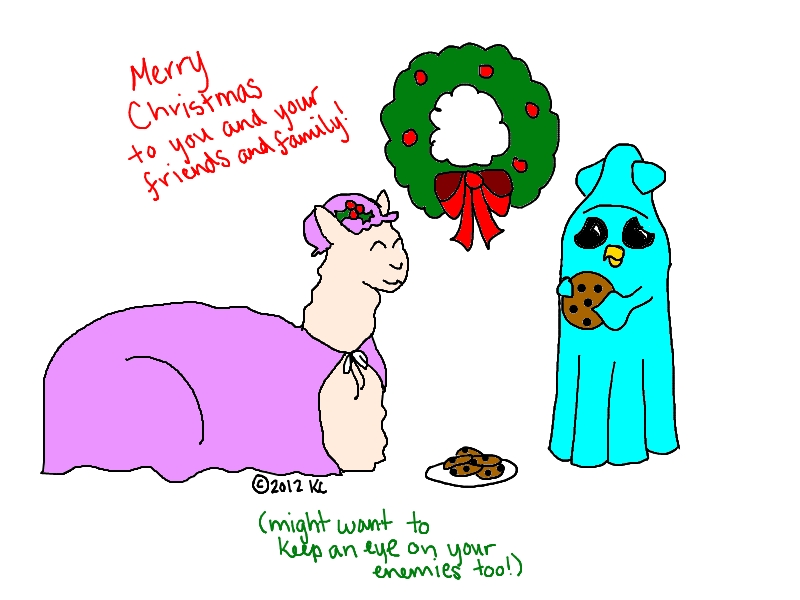
Landsquid left his house through the front door, carrying a basket of freshly made chocolate chip scones (which are the best kind) over one tentacle. He steeled himself, then quickly hurried down his front walkway, around the fence, and up to his neighbor and arch-nemesis Alpaca’s front door. He paused for a moment, listening, but there was no movement.

Landsquid hadn’t seen or heard from the Alpaca since he had attempted to take over the blog at the beginning of June. He’d been on house arrest ever since. Oh, Landsquid had been mad at first. There’d been the whole incident with being locked in the Alpaca’s basement with the ceiling turtles. FOR A WEEK. But at least he’d had some cocoa and Cheez-Its, and the ceiling turtles weren’t too bad, as long as you ignored them trying to gnaw on your head fins.

Landsquid paused for a moment to wonder what had happened to the ceiling turtles. Were they still in the basement? Had they escaped and made their way out into the wide world to find someone else’s head to drop on, or had they infiltrated the main part of the house, where the Alpaca was forced to stay?

That could be why Landsquid hadn’t seen him in a while. Hm.

Although, if the Alpaca was dealing with a ceiling turtle infestation, he’d been much too quiet about it. Landsquid had gotten used to the loud yelling that often drifted over the fence at even the most benign of times. But now, he’d been quiet for months. Landsquid was worried. It’d taken years to build up their relationship to the proper level of arch-nemesis-ness.

Before he could chicken out, Landsquid straightened his basket of scones and knocked soundly on the front door. At first, there was nothing, but then a long, strange dragging noise, just barely audible, started towards the door. It did not sound like the Alpaca at all. Landsquid clutched his basket tighter and debated fleeing. What was that noise, all slithery and light? He had horrible visions of some sort of forgotten creature, long resting in some deep, dark place, burrowing its way to the surface.

That could also explain why he hadn’t seen any ceiling turtles either. They’d be the first–and possibly the last–line of defense.

The door opened. Landsquid drew back, ready to flee if necessary, but it was an alpaca, wearing a ridiculously long afghan. Upon closer inspection, it was the Alpaca, though his usual mustache and monocle were nowhere to be seen. Instead, along with the afghan, he was wearing some sort of bonnet, and he had a pleasant smile on his face.

“Uh,” said Landsquid, thoroughly baffled. “How are you holding…up?”

“Oh, fine, fine,” said the Alpaca. “I’ve taken up knitting, you see. Very calming. Cheap–well, for me, anyway–too. Don’t have to leave the house, even if I could!”

Around the Alpaca’s fluffiness, Landsquid could see what looked like several ceiling turtles, crawling around on the floor, of all places, wearing turtle-shaped sweaters and booties.

“You should come in,” the Alpaca continued. “I’ve just got some new yarn spun. It’s a lovely shade of light yellow. It’d really bring out your eyes.” He kind of leered as he spoke. And now the typical ‘I am contemplating great evil’ leer that Landsquid was accustomed to, but more of a ‘I have been around yarn and ceiling turtles for too long and would like to knit you into a full-body stocking from which you will never escape, and then I shall feed you bon-bons and talk to you as if you weren’t really there’ sort of leer.

“Oh, no,” said Landsquid. “I’m afraid I can’t now. I’ve got to…wash my hair. But I brought you these scones, as, you know, sort of a ‘Don’t worry about trying to conquer my livelihood and feed me to ceiling turtles’ thing, you know.” He thrust the basket at the Alpaca. “Hope you like them. But I must be going I’m afraid. Yes, yes, well, I’ll see you later.”

He backpeddled up the walk and back towards his own house. As he went, he thought he might have heard the Alpaca whisper, “Yes, yes, you will.”

Books by Kit Campbell

City of Hope and Ruin cover
AmazonKoboBarnes%20and%20NobleiBookscustom
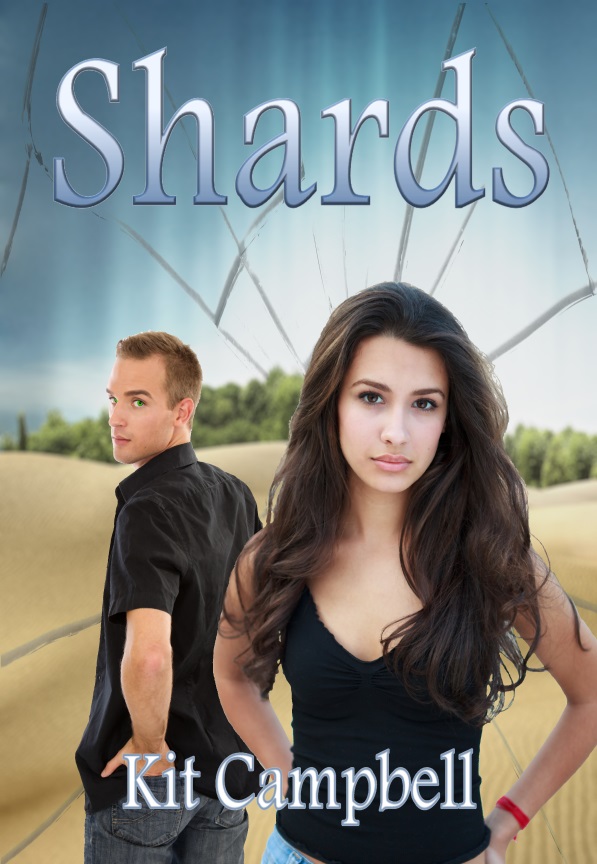
Shards cover
AmazonKoboSmashwordsBarnes%20and%20NobleiBookscustom
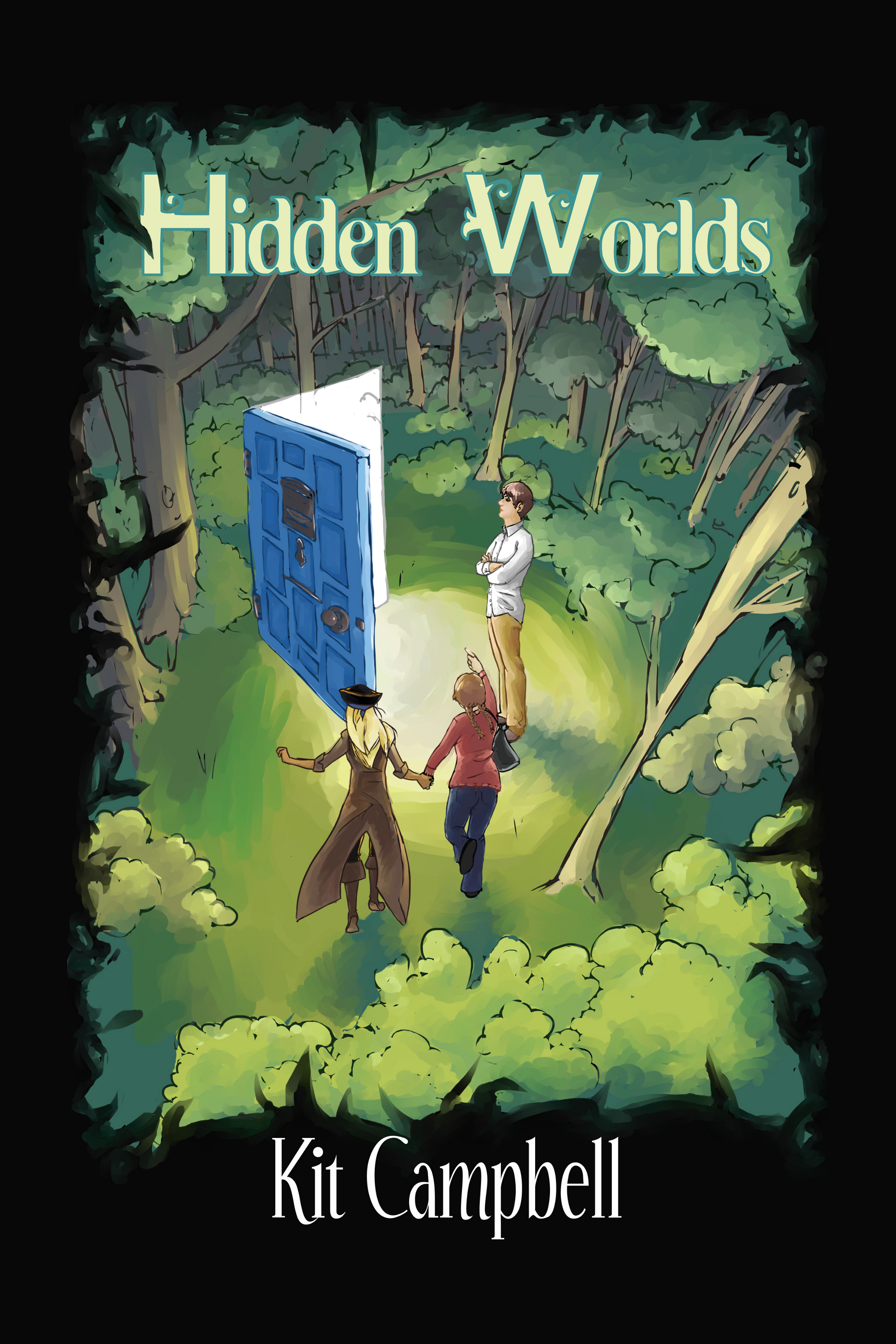
Hidden Worlds cover
AmazonKoboSmashwordsBarnes%20and%20NobleiBookscustom