Storytelling Across Cultures

They always say to read broadly, don’t they, squiders? And generally this means that if you normally read mysteries, pick up a romance every now and then, or some science fiction, or if you read novels to read short stories, or if you only read stuff from authors who are alike to you in race/gender/orientation, etc. to try authors who are different than you in one or all categories.

One could argue that reading stories from other cultures fits into this as well.

Have you ever read folklore and creation myths from different cultures? (I read a ton of creation myths at one point–I think it was research back when I was writing Shards–and it was very interesting to see what trended across cultures from different sides of the planet.) It’s really quite fascinating. I have a whole shelf of folklore here in my office–Russian, African, Hawaiian, American Indian–and even made it through the Kojiki at one point.

And stories take different mediums depending on the culture as well. And there are differences between the beats and flow even within the same medium. The kabuki theater tradition in Japan is completely different than Western theater (and is actually why people think ninjas wore black, though that’s another story). A puppet show in Europe is different than the shadow puppets of Asia.

Story structure varies as well. I was reading earlier about differences between “western” (in this case, American) and “eastern” (Japanese) storytelling. The article said that while western stories tend to depend on direct conflict and use a three-act story structure, eastern storytellers use a four act structure that goes “introduction, development, twist and reconciliation.” There can be–and often is–conflict, but it’s handled in a completely different manner. (If you’ve ever watched Spirited Away or another Ghibli film, you’ve probably seen this act structure in action.)

(Something else I read on the subject pointed out that in American storytelling, the main character is often the strongest, most interesting person in the story, with the other characters being relegated to sidekicks, whereas in Japanese storytelling, the main character is often an everyperson who is thrust into a situation where they’re surrounded by people who are more powerful and/or more interesting than they are. Which is true, to some degree, but I can also think of some examples where it’s not, so much like everything in life, there are always exceptions.)

What do you think, squiders? Feelings on stories and mediums from other cultures? Favorite stories from other countries? Thoughts on storytelling structure?

Announcing the Red Mars Readalong

All right, squiders. We’re going to do the Mars Trilogy by Kim Stanley Robinson for our next readalong.

I’m excited to do this one, because I have been carting this trilogy around for probably close to 20 years without reading it, and if you’re at all familiar with it, you know these are fat books. My copy of Red Mars (which is the only one handy–Green Mars and Blue Mars are currently relegated to the basement bookcase) is about 600 pages of tiny font. So not Wheel of Time fat, but pretty dang fat.

I think I picked the series up around the time I read Dune and Ringworld and books of those ilk. I think I thought the series was older than it was, since it seemed to be on all the same lists. It is a Nebula award winner, so that’s cool.

(My copy was also apparently once owned by my local library. I hope I bought it at a book sale and didn’t steal it off the shelves. It doesn’t seem to have the general library book accouterments such as stickers with shelving location and whatnot, so I’m going to assume it’s all good.)

I have also never read anything by Kim Stanley Robinson (though I believe these were some of his first books), though my husband recently finished 2312, so assuming he’s consistent in his narrative form, I have a vague idea of what to expect.

Let’s give ourselves plenty of time to get through this one. November 1 sound good?

(I will also note that I will probably read We Have Always Lived in the Castle, which was also on the poll, sometime in October, both because I want to, and because one of my writing groups is having a paranormal/horror reading challenge in October, and that’s the first one that comes to mind. So I may or may not talk about that one as well.)

Cool Things Round-up

Hey, squiders! It’s been one of those weeks, so I’ve decided to share some neat things for both readers and writers with you.

Reading

I’ve talked about BookRiot before, but I recently learned that they do tailored book recommendations. (To be honest, I also like how they’ve named it Tailored Book Recommendations and shortened it to TBR, which stands for To Be Read in most reading circles.) It costs money, of course. There’s two levels–recommendations only (and I’m unsure whether you get the actual books or just recommendations and then have to hunt the book down yourself) and hardcover. (…why hardcover? I don’t want a ton of new hardcover books every quarter, but I suppose people must, or they wouldn’t offer it.) If you’re always looking for new books to read, this might be worth it to you.

Two weeks ago I took over the social media accounts for Hometown Reads. (And also Hometown Authors, but that’s for the other section.) If you’re unfamiliar with Hometown Reads, the idea is connect readers with local authors, so they can support them. The website is divided into cities (alphabetical by city name), and then once you click on your hometown, it shows several pages of books by local authors. The books rotate through, so you may get new and different books each time you check. You can also search by genre, though this gives you books from all the locations, and can search books/authors by name in a search box.

Writing

One of my favorite writing teachers, Holly Lisle, is launching a new course tomorrow, called How to Write a Novel. This is a brand spanking new class, so I haven’t taken it myself, and I’m also not sure how it differs from (or if it’s to replace) her How to Think Sideways course. I think it may be more specialized–HTTS also focuses on idea generation and how to find markets and the like. So! I don’t know about this particular class, except I have seen the outline for it and it is very very VERY thorough, and her How to Revise Your Novel course was a game changer for me.

(Also, I took her free How to Write Flash Fiction course and sold three of the four stories I finished, so…)

Edit: Oh, hey, reading comprehension–apparently if you get in the early bird launch, you get a full content edit of your manuscript for free, so that’s a pretty nice perk.

On the other side of Hometown Reads is Hometown Authors, which connects you to other authors in your local area, and also offers a marketing blog and other occasional resources. You can also maintain an account that shows up over at Hometown Reads, that links your books to you and where to buy them.

Another resource I came across fairly recently is Authors Publish. This is a free resource that emails once a week or so with a selection of markets you can submit to. These tend to be themed (one week may be publishers for romance novels, another week may be themed short story submissions, another might be new publishers), and they also occasionally release ebooks on various marketing and submission topics.

Well, that’s it for me for today. Found anything cool lately, squiders?

Time for a New Readalong!

It’s been almost half a year since we read The Sparrow, so let’s pick out a new book and/or series to look at! I’ve tried to provide a wide variety of genres and standalone/series options.

Also, if you’d very much like to do a different book or series, please let me know in the comments.

Also let me know if you prefer if I just pick a book on my own. The polls are still a new thing.

Readalong time! Pick a book:

View Results

Loading ... Loading ...

Sad Cake

We recently received a free trial of Netflix. I’m not a big television watcher, but in an effort to justify Netflix’s existence on our Roku, I’ve started watching The Great British Baking Show, which I’ve heard good things about.

Full disclosure: I am a horrible baker.

(Well, I bake a mean pie. My apple pie is apparently divine. I don’t actually know, because I don’t like pie and only bake them for other people.)

The other day, I was watching the GBBS with the small, mobile ones, who were actually way more into it than I thought they would be. I mean, it’s essentially a load of people with funny accents (but then, the younger one is rather into Peppa Pig, so perhaps the accents aren’t that weird to them) talking incomprehensibly about pastries and gluten and proofing and a ton of things I don’t understand, but hey. I was tired and they were staying put.

Then the bigger one proposed that we make a cake of our own.

My first instinct was to squash that idea like a bug, but parenting, much like improv, often involves saying “yes” to things you don’t want to, so I fished out a cookbook that seemed likely to have cake recipes (Better Homes and Gardens, 12th edition) and decided on chocolate sponge cake, since the people on GBBS are always making sponge cake.

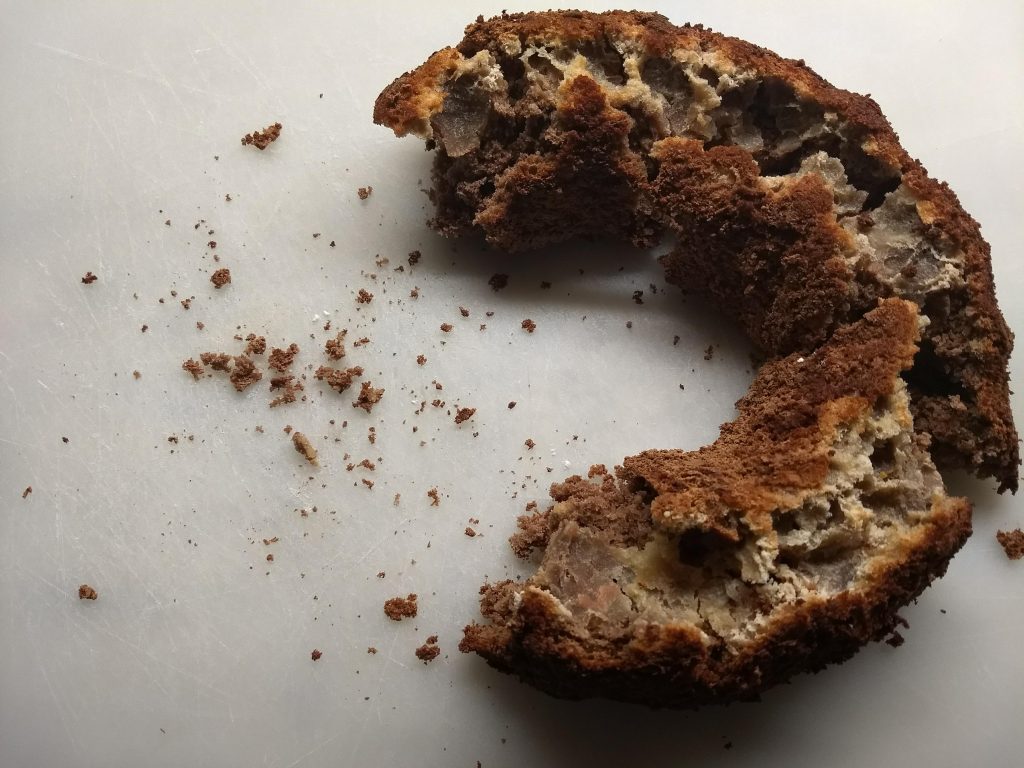
It took us about two and a half hours, all told. And we ran completely out of sugar. But we baked that cake, and we let it cool, and we finally pried it out of the bundt pan, and…

sad cake

(We’ve eaten part of it. For solidarity.)

I’ve yet to figure out how to get a cake out of a bundt pan successfully. As you can see, the top stayed with the pan. And we definitely overcooked it. And the bigger mobile one apparently had grand plans to copy the show participants and create an elaborate scene on top with frosting and candy and what have you.

(This was circumvented by pointing out that we had no sugar and therefore could not make frosting, though it didn’t stop him from sticking several lollipops into it.)

It doesn’t taste terrible. But as far as cakes go, it’s pretty sad.

Are you a decent baker, squider? What’s your favorite recipe? The small, mobile ones have expressed interest in trying again once we’ve bought more sugar.

(Tips on getting cakes out of bundt pans? It doesn’t matter what kind of cake I’m making, it’s invariably mangled in the extraction process.)

Literary Namesakes

My sister recently dropped off a book for me to read (along with some llama socks and a Totoro keychain, woot woot) that featured her name in the title.

Me: “Did you pick this up just cuz the main character is named after you?
Her: “Yes.” A pause. “But I think you’ll really like it.”

And to be fair, I’m a little over a fourth of the way into the book, and I do like it. So I give her that.

But it is kind of fun, isn’t it, when you open a book and find a character with your same name? Well, unless the character is a jerk. Or your name is so common that there’s another one everywhere you look. Or you share a name with somebody super famous (can you imagine all the Harry Potters out there?).

At least for me, though, “Kit” isn’t terribly common, so it’s still exciting when another one comes out of the woodwork, but it’s common enough that it does come out occasionally. Though, being a gender neutral name, I did go through a period of time where all the Kits I found were male. Kit Cloudkicker in TaleSpin, a male griffin in The Dark Lord of Derkholm (by Dianna Wynne Jones), etc.

(Not that there aren’t female Kits, of course. There’s an American Girl named Kit, after all, though I will admit to never reading any of those, since she came out after I’d moved off of American Girls. And Kit Tyler from The Witch of Blackbird Pond, which I think was required reading back in elementary school.)

And, like my sister, I will admit to picking up a book if I know the main character is named Kit. I did that with Down a Dark Hall by Lois Duncan, which is a supernatural story taking place in a boarding school, and with a mystery that I can’t recall the name of where the central mystery revolved around something that could have been solved with a 5-second Google search (the book predated Google, but I was still annoyed that that-Kit couldn’t do some basic research somewhere).

What do you think, squiders? Do you like opening a book and finding your own name staring back at you? Or does it weird you out?

Working with an Ensemble Cast

I’m to the climax of the space dinosaur book, which is exciting! And also scary, because I’m trying out fencepost outlining for this particular project (basically, you identify the major plot points for your arcs–first plot point, midpoint, second plot point, etc.–and that’s about it) so I’m not 100% sure how this is going down, but sometimes that’s part of the fun!

This book is meant to be the first book of a series, and as it takes place on a spaceship with a crew of about 150 people, there’s a lot of people to deal with. It can be overwhelming. So what are you to do when you’ve got a ton of people to keep track of?

Well, me, I’m taking a page from one of my very favorite science fiction series, Star Trek: the Next Generation. (And arguably other Trek franchises, like Deep Space Nine and Voyager.)

Next Gen had a core cast of characters–Picard, Riker, Data, Geordi, Deanna, Beverly, Worf–as well as several reoccurring characters, such as Barclay, Chief O’Brien, Q, Guinan, that nurse whose name is slipping my mind, Wesley in later seasons, etc. In general, you got a good idea of the scope of the ship without getting overwhelmed by everyone on it.

So when I started setting up my cast, I focused on my core crew, which looks like this:

(Remember what I said about character images from last week.)

(Also, if you can’t read names–I have never claimed to be decent at digital art–it goes Ari, Brian, Chris, Dave, Lin, Robin, Roya, Tom.)

That gave me a good spread across the ship–these people are essentially in charge of different departments. (And, well, space dinosaur.)

However, depending on the type of story you’re writing, eight viewpoints is a lot of viewpoints. A thriller where character is less important and you can have a multiple of viewpoints is one thing. But I wanted to have characters people could identify with, that they’d follow along with for the entire series. That they’d care about. So I decided I’d do three viewpoints per book, with the focus being on who is most involved in the plot for that book. The main plot for this book involves an unknown saboteur who somehow manages to get around all the security measures, so the engineering characters have a lot to do. Other people–medical or science staff, for example–are around, and do contribute, but it doesn’t make sense to give them viewpoints here.

And in writing this book, some of those secondary characters, the ones that make a ship feel like a real, working vessel and not just a backdrop for the officers, have already started to show up. I’m taking note of them so I can use them throughout the series. I don’t know if they’ll ever become viewpoint characters later down the road, but, hey, anything’s possible.

I mean, Chief O’Brien didn’t even get a name for two seasons and went on to be the chief engineer of DS9.

What are your favorite ensemble casts, squiders? Any thoughts on how they’ve been handled, good or bad?

How to Picture Characters

Good news, squiders! I did not have to go to jury duty today! (Obviously.)

(Also, I wanted to note that I put The Wanderer as MG historical in my box of books post, and it is straight MG. Not sure why I thought it was historical.)

I am not the most visual of authors, but I know a lot of people like to use images to “see” their characters. Or other people’s characters (hooray for fanart!). So, if this is you, I thought I’d give you a few resources to use to hunt down characters or build your own if you already know what they look like.

(I find having pictures of my characters useful for showing other people. I typically just need a name to get a fully formed character when actually writing. But everyone’s different, and that’s okay!)

If you know what your characters look like

As I said, I typically just need a name, and then everything else kind of falls into place. Sometimes I will start with a visual (I want them to be this ethnicity, or have this color eyes, or whatever) and then go for a name, but normally they show up and come with their own details.

If you’re artistic, you can try drawing your characters. I do this periodically with mixed results, because I never quite got past a middle school drawing level. (And also I was obsessed with the anime-style drawing at that point and it shows.) Also I don’t know how to color, so I typically get line drawings I’m happy with and then ruin them by digitally coloring them.

If you’re not artistic, never fear! There’s a lot of character generators out there! Some are specifically designed to do forum avatars, and tend to be from the shoulders up. Search “avatar maker” and you’ll find a ton of them. “Character creator” typically works for full-body ones, and here’s a reddit thread about decent ones.

They do tend to be a bit specialized, so you might need to poke around a bit to find one that will work for you. Here’s a picture of my character Ali that I whipped up just for this blog post on HeroMachine. (It’s specifically for making superheroes or other scifi/fantasy characters which makes it not awesome for character like Ali, who is a contemporary high school student, but I’ve used it forever so I’m used to how it works.)

Ali pic

(Alternately, here’s a pic of Briony from City of Hope and Ruin, also using HeroMachine.)

(There’s a lot of bare midriffs for the ladies in HeroMachine land.)

I don’t know what my characters look like and/or I prefer real people

(Or at least more realistic drawings)

Hey, too bad there’s not an entire Internet out there with pictures of things! Here’s some places to look:

  • Pinterest – there’s even a handy-dandy search bar, right at the top!
  • stock photo websites – Again, handy search bars. Harder to find some weirder things. I remember, when we were working on the cover for Shards, it was near impossible to find a guy looking over his shoulder that also had a shirt on. Additionally, if you find a picture you really like, you can normally purchase it (for a fee) and then you can legally use it in promotional material and stuff like that.
  • Portrait-photos.orgLike HeroMachine, I’ve been using this website for literally forever, ever since someone first brought up trying to match characters to real people for use in avatars, practice covers, Nanowrimo banners, etc. You search by keyword (I usually do this by clicking on a keyword under a picture and then replacing it with what I actually want to search for). I like that this website has a wider selection of people than just “pretty, young people.”
  • Flickr
  • deviantArt

A note about copyright: Please do not just steal pictures off the Internet. If you’re making an icon or a banner or even a cover just for fun, it’s probably okay, but if you’re going to be using them for a real cover or promotional materials of any sort, you need to make sure you have permission to use the image. There are some stock photo websites, like pixabay, that specifically host public domain images, and you can purchase images off other ones. Websites like deviantArt and Flickr usually list the copyright information under each picture. A lot of artists use Creative Commons (CC), and some CC copyrights allow for personal use or modifications. Just be aware.

And if you want to see a lot of old drawings, icons, and banners of various book projects…well, here you go.

(Okay, some of the banners aren’t so old.)

(Also, there’s some landsquid.)

What resources do you use to picture characters, squiders?

Be Jealous of My Box of Books

So, everyone I know is moving this week.

Okay, not everyone, but five people. It’s still a lot. And all at the same time.

One of the things about moving is that you realize how much stuff you’ve wedged into your current place, and how a lot of it you haven’t touched in years. Luckily for me, my family has realized they have a lot of books that they’re never going to read again.

And now they’re mine, bwhahaha.

My grandmother is an avid mystery reader and had a ton of books she’d already read, and my mother was offloading MG/YA science fiction and fantasy that she’d needed to keep up with what her students were reading, but doesn’t need them now that she’s retired.

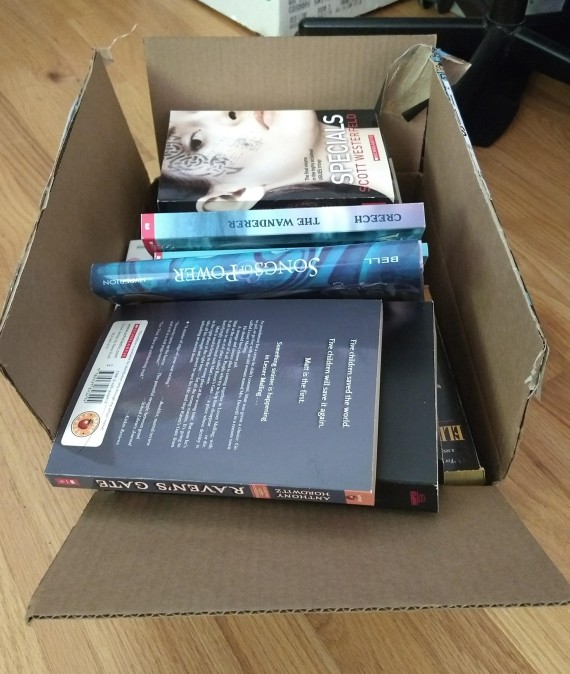
Here’s my haul:

Box of Books

Mysteries/Thrillers/Gothic:

  • Lion in the Valley, Elizabeth Peters (1986)
  • The Ipcress File, Len Deighton (1962)
  • A Cold Day for Murder, Dana Stabenow (1992) (haha, her name has “stab” in it)
  • The Man with a Load of Mischief, Martha Grimes (1981)
  • Booked to Die, John Dunning (1992)
  • The Missing Mr. Mosley, John Greenwood (1986)
  • Mosley by Moonlight, John Greenwood (1985)
  • Mists over Mosley, John Greenwood (1986)
  • The Mind of Mr. Mosley, John Greenwood (1987)
  • What, Me, Mr. Mosley?, John Greenwood (1988)
  • Smoke in the Wind, Peter Tremayne (2001)
  • “A” is for Alibi, Sue Grafton (1982)
  • Raven Black, Ann Cleeves (2006)
  • Edwin of the Iron Shoes, Marcia Muller (1977)
  • The Haunted Bookshop, Christopher Morley (1919)
  • The Scapegoat, Daphne du Marnier (1956)

YA/MG Fantasy/Scifi:

  • Uglies, Pretties, Specials (trilogy), Scott Westerfeld (2005-2006)
  • The Vampire Diaries (books 1-4), L. J. Smith (1991)
  • Songs of Power, Hilari Bell (2000)
  • Raven’s Gate, Anthony Horowitz (2005)

Other:

  • From the Mixed-up Files of Mrs. Basil E. Frankweiler, E. L. Konigsburg (children’s, 1967)
  • Lord of Legends, Susan Krinard (romance/fantasy, 2009)
  • The View from Saturday, E. L. Konigsburg (children’s, 1996)
  • The Wanderer, Sharon Creech (MG historical, 2000)

(I really like E. L. Konigsburg. Or I did as a kid.)

What do you think, squiders? Read any of my new acquisitions? Where would you start if you were me?

Books by Kit Campbell

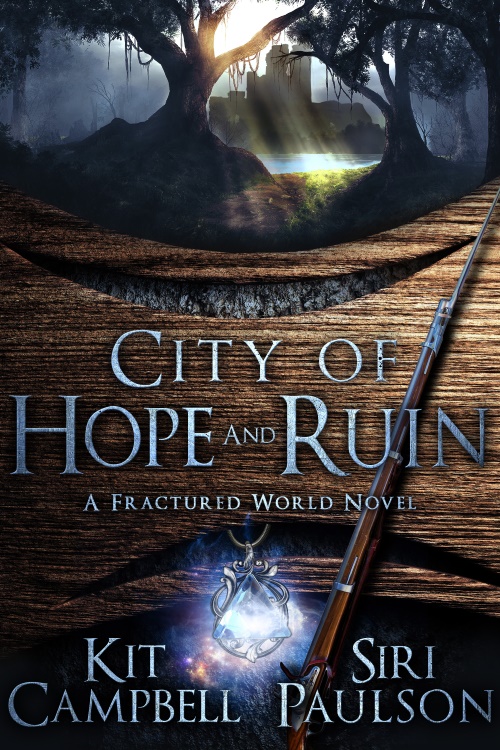
City of Hope and Ruin cover
AmazonKoboBarnes%20and%20NobleiBookscustom
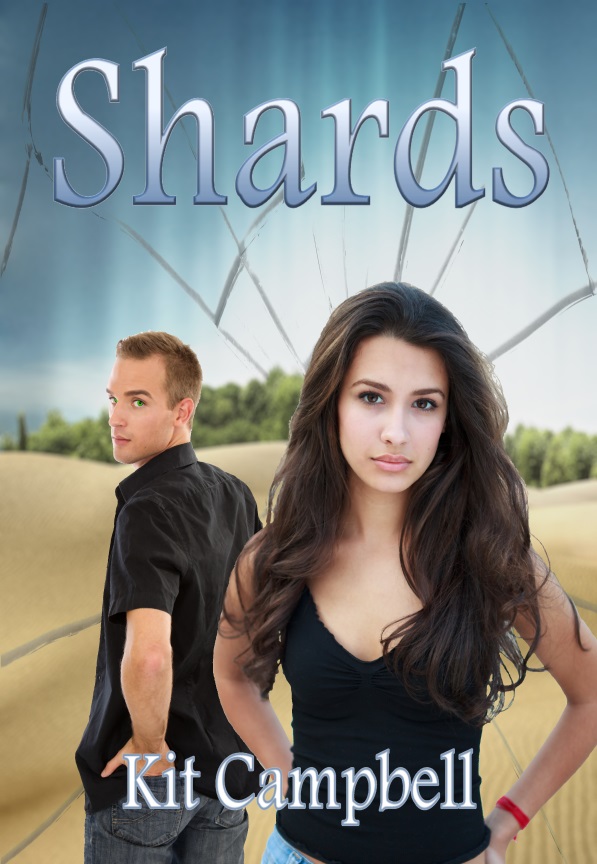
Shards cover
AmazonKoboSmashwordsBarnes%20and%20NobleiBookscustom
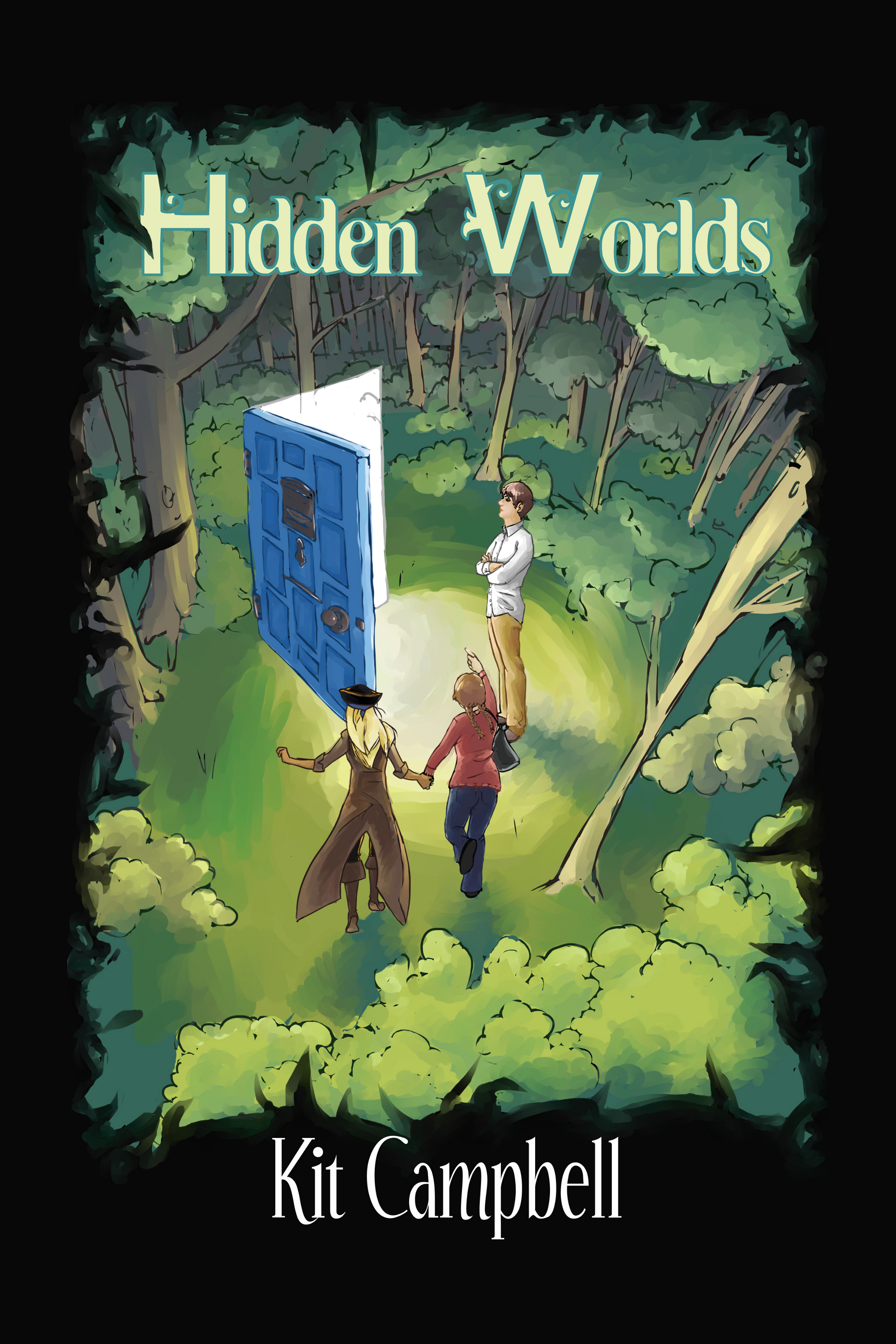
Hidden Worlds cover
AmazonKoboSmashwordsBarnes%20and%20NobleiBookscustom