Musical Interlude

Let’s continue our never-ending attempt to see if I can get YouTube videos to embed here.

You guys know that I think music is an excellent way to help you get tone and mood when writing, and depending on what you’re listening to, can also help inspire scenes, characterization, or even whole plotlines.

I’ve got a ton of work on my hands at the moment, so today I’m going to share five songs that I’ve recently heard on the radio that have caught my interest (not necessarily from a story-telling point of view). Some of you guys may find some inspiration in them. Let me know in the comments if you’ve heard these and what you think of them.

First up: Cheap Thrills by Sia

I like the beat but this one is sadly starting to enter “overplayed” territory ’round these parts. Oh! I also take absolutely no responsibility for the music videos.

Next: Just Like Fire by Pink

It’s sad that this song is linked to what I hear is a terrible movie, but alas.

On to: Critical Mistakes by 888

My husband tells me this video is sad though I have not watched it myself. This is a local band, as is the next one, I believe.

Ontowards: Your Love Could Start a War by The Unlikely Candidates

This one is the most plotty for me, personally.

And finally: Tell Me Baby by the Red Hot Chili Peppers

I know this is an older song, but for some reason it’s been getting a lot of airtime lately, which reminds me that I like the chorus.

Any good songs you’ve heard lately? Share!

Have We Gone Too Far?

Have you ever had a scene that is in such bad shape that it just makes you want to flail incoherently?

Editing Notes

Yeah, me too.

But, in other news (I totally wrote “noises,” which I credit to my in-laws watching a football game in my general vicinity), we did fantasy conventions and subgenres at storycraft this week, which I was greatly looking forward to, since fantasy is my general cup of tea.

(For the curious, our list of conventions for fantasy includes: 1) includes some fantastical element–which can include setting in some cases where magic or something obviously fantastical is otherwise missing, and 2) isn’t some other genre, which, frankly, is a terrible definition but hey, it tends to be true.)

Unlike horror and scifi, however, we discovered that most of the lists of fantasy subgenres included something around 50 different subgenres. Which is a ridiculous amount of subgenres. An unnecessary amount of subgenres.

As one of the other writers noted when we got to “futuristic fantasy”–now they’re just being greedy.

On one hand, subgenres can be helpful. Fantasy is a large, broad, diverse genre–and someone who reads Tim Lebbon or George R. R. Martin may not like Robin McKinley, and vice versa. Subgenres can help a reader tell if they’re likely to enjoy a book.

But there does seem to be a limit to the usefulness. How deep do most readers–or writers–get when they’re looking at subgenre? Major subgenres like paranormal romance, dark fantasy, or urban fantasy are clear and imply certain themes and tone.

But the smaller or more obscure subgenres–do we need to go that far? Do we need to break everything down to the smallest common denominator and make yet another subgenre for it?

What do you think, Squiders? Is it worth it to break everything down as far as it can be broken down? Or is the whole thing ridiculous?

Smashwords vs. Draft2Digital

I’ve seen a lot of people talking about doing a wide distribution of ebooks (i.e., not just Amazon) lately, and, as someone who has never done Amazon exclusively, I thought it might be helpful to some people to do a quick rundown of the two major ebook distributors.

(As a quick aside, there’s two general ways to do ebook distribution, assuming you are doing it yourself and your publisher isn’t doing it for you. One is to upload your book individually at each ebook service. The other is to use an ebook distributor, which is what we’ll talk about today.)

Everybody knows Smashwords–it’s probably the biggest name in ebook publishing after KDP. I use Smashwords for the distribution of both Hidden Worlds and Shards. But there’s a new kid in town, which is Draft2Digital (or D2D, as I will refer to it moving forward). After some research, Siri and I decided to use D2D for distribution of City of Hope and Ruin.

Why did we forsake Smashwords? Well, let’s look at each service individually.

Smashwords is the big kahuna. You upload a document, which goes through Smashwords’ meat grinder and gets turned into a variety of formats, which you can then have distributed to the channels of your choice, assuming your manuscript passes muster to get into the Premium catalog. Additionally, you have a page on Smashwords itself where people can buy your book and leave reviews.

Smashwords distributes to a number of retailers, such as the iBookstore, Barnes and Noble, Kobo, etc. They also work with libraries so that libraries could potentially download your book into their systems. You can set a specific library price which is different from your sales price.

Occasionally Smashwords has site-wide sales that you can enter your book into rather easily (normally just by indicating how much on sale you’d like the book to be).

Draft2Digital is smaller and newer. It also distributes to the iBookstore, Barnes and Noble, Kobo, etc. It doesn’t have a library option as of yet, however. D2D does not have a sale page for your book on their site, but does give you a universal link that lists all available retailers (you can see the one for CoHaR here). It’s a leaner service than Smashwords, and distributes to fewer retailers.

Okay, pros and cons.

Smashwords is massive and has a huge reach. Most of the books I have sold on the site have been during sales, so I appreciate being able to jump into those with a minimum amount of effort. The sale pages are nice, though I’m not sure how many people use Smashwords as the main way they buy ebooks. The meat grinder is a pain in the butt. It’s gotten slightly less picky over the years, but essentially you have to strip all formatting out of your manuscript to get it to take it. So the version of your book that goes out to the retailers is pretty plain. Additionally, it can take a long time for your books to show up at said retailers, to get payments from the retailers, or to update changes. Every time you change something, you have to go through re-approval for the Premium catalog as well, which is a bit of a pain.

D2D is smaller, as I said above, and doesn’t distribute as widely. They also don’t convert to as many formats, only epub, mobi, and PDF, though one could argue that you don’t need much more. (Smashwords does have an online reader that you can open on their website, which is arguably nice.) What is nice about D2D, and is a major reason we went with them, is that they update fast. Changes go up in less than a day, which is good for, say, price changes at the end of a sale and whatnot. Sales and payment go through a lot faster as well. This may be purely coincidental, but I’ve sold a lot more copies of CoHaR through the retailers than any of the books uploaded at Smashwords.

So I guess it depends on your end goals and what is more important to you. And I know some people upload to both, so they can have the sale page on Smashwords and the potential library distribution, but still make use of D2D’s faster distribution and payment.

Have one service you prefer? Used one or both? Have horror stories? Inquiring minds want to know, Squiders.
How Much Can You Plot the Heart of a Story?

I’m not going to lie, Squiders. I’m having a ton of issues with the edit on the first book of my fantasy trilogy. I’m getting nowhere fast, and even when I do get somewhere, it’s only to find myself facing a cliff face with insufficient climbing gear. I’ve never had so many issues. Normally, when I do an edit, it’s more of organizational exercise, with clear goals in sight. This is just a mess.

As a short background, I decided to write this trilogy at 16, based off some roleplaying I’d done with some friends (not your classic ‘I’m going to write a novel off my D&D campaign’ riff though–this was based on Star Trek). For my second Nano in 2004, I wrote the first draft, mostly based off my 16-year-old thoughts. That draft was extra terrible, but it was the first draft I ever finished. In 2009/2010 I wrote the current draft of the story, addressing a lot of worldbuilding issues from the original draft, as well as some plotting issues. That’s the draft I’m working on now.

When I revise, I tend to follow the method Holly Lisle lays out in her How to Revise Your Novel course, with some modifications, since I’ve used the process several times over at this point and know where I have issues. (For example, I always lay out a calendar and place key events on it, so I have an idea of what happens where and can visualize time passing, which is not something she includes but is something I need.)

(It’s an excellent class and I recommend it, but I don’t believe it’s currently available.)

Normally it’s just the process of going through everything and working through it, and then I’m good to go for the actual revision. This time it’s like pulling teeth.

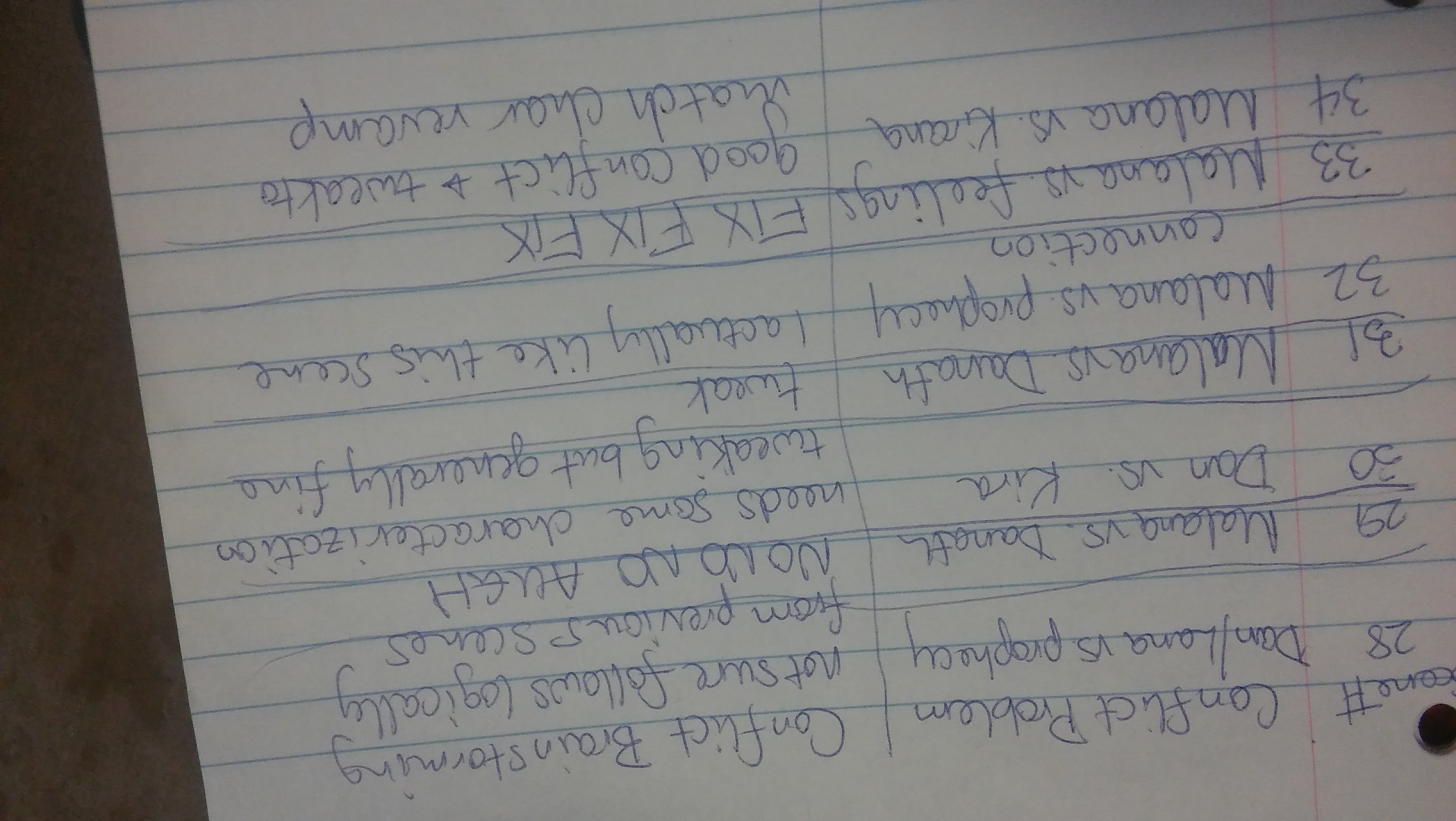
During the fourth step, you’re supposed to identify your core conflict. And it took me several days, and even then, I had to go with a different conflict than is written in the book, because the current core conflict doesn’t work. The current step is to identify what matters about the story, the reason people will care about and remember the story for. I spent about half an hour last night just staring at my notebook. Overnight I think I’ve worked something out, but I’m still not sure it’s quite right.

This morning I had the thought that instead of hodgepodging this book together over 15 years, I wish I had outlined. But then I got to thinking, well, yes, the plot is a mess and could have maybe been saved if I had outlined (though I think I did outline the current draft, at least a bit), but what about this heart and soul sort of stuff? Can you sit there before a story is written and say “these are my core themes, this is why this story will resonate, and this is why people will care”?

I’ve certainly never done it. But normally, when I go through this revision process, that stuff has already been built in subconsciously. And maybe this story had this too, once upon a time, but it’s gone through so many iterations and rewrites and complete upheavals that whatever that original core was is gone. Or maybe, when I first started this story oh so many years ago, I didn’t understand that a story needed that sort of thing.

Who knows? But now I face the laborious task of adding it back in. Do not envy me, Squiders. This is not fun.

What do you think, Squiders? Can you plot out the core of your story, or is that something that has to come more naturally?

Tie-in Fiction Friday: Only Human (Doctor Who)

Doing a little better than a year and a half between posts, eh?

For Doctor Who’s 50th anniversary back in 2013, they put out a collection of books, one for each Doctor, that were special 50th anniversary re-releases. It was all very shiny but expensive, so I decided I would buy one book, though at this point I don’t remember my selection criteria. Did I buy this one because it was the one for Nine, who was my favorite Doctor at the time? (I now am also fond of Twelve. And Two.) Did I like the plot write-up the best? I’m not sure.

Anyway, I ended up with Only Human, written by Gareth Roberts, and initially published in 2005. The shiny 2013 re-release cover looks like this, in case you’re interested:

Only Human Cover

The basic premise is that the Doctor and Co. (in this case, Rose and Captain Jack, ?) pick up a time distortion and trace to a Neanderthal being about 28,000 years out of place (in this case, modern day England, 2005). The distortion is caused by a primitive and dangerous time machine called a rip engine, which makes it so people who use it can’t go back to their original time. So the Doctor and Rose bop back in time to see if they can’t find this rip engine back 28,000 years ago while Jack is left to teach the Neanderthal how to adapt to modern life (not like Jack is terribly familiar with 2005 either, great planning).

The story is mostly Rose and the Doctor doing their thing back in the day, interspersed with diary entries from Das (the Neanderthal) and Jack. Das’s entries are hilarious and easily one of my favorite parts. While I would not call this high writing in any form, the interactions between Das/modern life, Rose/past humans, etc., are all very well done and also funny. The characters are also mostly spot on though a little thin in places.

This was a quick, fun read–only 253 pages. It reads like a Nine-era episode and has about the same depth as one. If you are familiar with Doctor Who/the Ninth Doctor, I’d recommend it. I’m not actually sure that someone who wasn’t relatively familiar with the show would have any idea what was going on. But maybe I’m not giving people enough credit. Aside from the characters and the TARDIS, there’s not a lot of mythology included.

Read Only Human, Squiders? Read any other Doctor Who books that you really enjoyed?

The Fluidity of Genre

We’ve been going through genre conventions at my storycraft meetings, Squiders. We were supposed to do all three speculative fiction genres at a single meeting–horror, science fiction, and fantasy–but we started with horror and two hours later were still happily on horror, so we’ve broken it up. We did horror, and last night we did science fiction, and in two weeks we’ll do fantasy, and I had a request from one member to do a discussion on cross-genre, specifically spec fic romance, so we might as well just roll right into that one too.

The meetings have a very loose structure. We spend the first hour trying to agree on genre conventions, then we read through the Wikipedia article on said genre and fight with it (and also read the history part, and so last night I learned that “scifi” was originally–and potentially still?–a term for low brow, low quality pulpy sort of media, and “science fiction” is/was for serious, worthwhile media. Which seems on level with the Trekker/Trekkie semantics, but hey, whatever, we all like to feel superior somehow). And then we go through various lists of subgenres and fight with those too.

A subgenre, for those who may not be familiar with the term, is essentially a further breaking down of a genre. If you know you’re specifically looking for dragons and elves, it helps to know what subgenre you’re looking for, especially with the dawn of online retailers like Amazon who get a bit ridiculous in their breakdown. Several years ago I did a science fiction/fantasy breakdown of several subgenres, which you can see here (though I realize that I never did do a final update to the master list. One more thing to do).

For horror, we had a decent list of conventions (and I should point out that this is specifically for speculative horror):

  • Often no final resolution, leaves the reader in a state of unease
  • Protagonist is often shaken to core
  • Plays on fear
  • Incorporates elements of the unknown
  • Tends to twist common things into something terrifying
  • Often includes a betrayal of safety
  • Often includes themes of isolation

For science fiction, we all agreed on exactly one convention:

  • Has a connection to modern humanity

We couldn’t even agree that science fiction had to be about technology, especially since a lot of recent fantasy has become very technological in scope. So the best we ended up with, especially to separate science fiction from fantasy, is that there had to be a connection to now. Some thread of “us,” no matter how far in the future or jumping through the dimensions. Some way that “we” directly become “them.” In a fantasy world, you can have humans without having those humans have any connection to the real world or history or anything of that ilk.

That’s not to say that fantasy can’t have a connection to modern humanity, just that that was the one thread we could agree upon that defined science fiction. And even that is probably too limiting, because there are probably science fiction stories out there without a human being in sight.

At least we’re not the only ones confused. Wikipedia included one author repeating the general definition of pornography, i.e., I know it when I see it.

Even the lists of subgenres seem a bit confused. You have things like “cyberpunk,” which has clear themes and tones that are fairly universal throughout the subgenre, but also things like “time travel,” which sticks something like Doctor Who or A Connecticut Yankee in King Arthur’s Court into the same category as The Time Traveler’s Wife, Outlander, The Time Machine, or Connie Willis’ Blackout/All Clear. With a cyberpunk book, you generally know what you’re getting; a time travel book could fall anywhere in the fiction spectrum.

We’ve got a going challenge to try and organize the scifi books we own into seven subgenres, and then we’re going to share our subgenres at the next meeting and see what we come up with.

I almost feel like subgenres exist so we can try and get a handle on what a story is, but it may all be a lost cause.

What do you think, Squiders? Agree with the conventions we came up with? What conventions do you use to separate the major specfic genres? Do you agree with my cohort’s postulation that the speculative fiction genres are converging again into a single genre ala the 1800s, or is it more of a convergent evolution sort of thing?

PitchWars, Tours, and Miscellany

Oh, Squiders, what a week I’ve had. Did I tell you that my stove caught fire? I think I did. It looks like we might actually get some money from the repair company, though! (We had someone out to check a burner on it–then the next time the burner was turned on, the entire electric system went up in flames.) But I also had to get the brakes replaced on my car, get a radon mitigation system installed, interview painters because we had a whole bunch of hail damage, etc. But in somewhat positive news, I’ve finally had the trim taken off the car so at least I never have to deal with that madness again.

Anyway, it’s been rough. I mostly want to burrow under my desk and read trashy romances and old Star Trek novels but, alas, I am an adult and have adulting to do. I mean, not that it’s getting done in a timely fashion, but I’m at least pretending.

In writing news, here’s what I’ve been up to:

  • I’ve got a new City of Hope and Ruin related prequel short story up for free over at Turtleduck Press! So if you liked CoHaR and would like more, there you go! And if you haven’t picked up CoHaR and would like a taste, tadah, free story! There’s also a free excerpt available.
  • So, apparently the application window for PitchWars was the 3rd thru the 6th. I like the idea of Twitter pitches and so have had the schedule open since January, yet have somehow managed to miss every event anyhow. PitchWars is a little more complicated–you pick four mentors and send in your first chapter and query letter, and if they pick you, they’ll help you polish your manuscript and query, and then in November they’ve got a panel of agents that look at the submissions, and I guess there’s been great success at people getting traditional publishing deals through it. Since there was a multi-day opening, I actually heard about it in time to get an application in for my YA paranormal novel, which I’m planning on going more traditional with.
  • I did, however, send in my application about 3 hours before the window closed. I guess if mentors are interested, they’re sending partial/full requests, and you’ll know you were selected before the official announcement on the 26th. I’ve heard nothing. It could be that I’m at the bottom of the queue and people haven’t gotten to me, or it could just be that I was so late into the game that people already had their eye on favorites. Or my submission could suck, but I’m trying to be optimistic.
  • I’ve finally got some momentum on editing the first book of my fantasy trilogy. It needs so much work. But I’m starting to see what it could be, and that normally helps on the motivation front.
  • But seriously, it needs so much work.
  • I joined Wattpad! You can find my profile here but I haven’t done much as of yet. A very nice author (whom you can find here) has been a doll about taking me under her wing and telling me how the site works.
  • We’re doing a space princess anthology for Turtleduck Press this year, so I’ve been working on that. I’m rather pleased with my story for it. I had a lot of fun doing science fiction instead of my normal fantasy–and space adventure science fiction at that.
  • Our long-term blog tour’s on right now. We’re giving away a $50 gift card again, so stop by any of the stops to enter. Thus far we have:
  • All stops have excerpts and blurbs and what have you, as well as tons of ways to enter the contest for the gift card.

I think that’s it in a nutshell. How are you, Squiders? Have you gotten up to anything fun or exciting lately?

The Adventures of Kate Readalong: The Ancient One

Aha! I bet you thought we were never going to get here! (Believe me, I was starting to feel that way too.) But here we go! And hopefully we run into less issues with the final book, The Merlin Effect.

As you guys are probably sick of hearing me saying, The Ancient One was a formative book for me, and reading back through it now, I can definitely see its influence on me and my writing. (As I said to a friend who was trying to guess which character/world I wrote in City of Hope and Ruin, if left to my own devices, my characters invariably end up in a forest.)

Anyway, The Ancient One, second book in the Adventures of Kate or the Heartlight Saga and, I believe, the most popular one. It’s got a score of 4.1 on Goodreads based on 1471 ratings, and a 4.7 on Amazon. Originally published in 1992. Did you guys read along with me? What did you think?

For a quick summary, Kate is visiting her Great Aunt Melanie up in a small logging town in Oregon. Next to the town is a large, unexplored crater, which has been left alone due to the interior being mostly concealed in fog and there being no way to breach the crater wall. Unfortunately, during a recent flight, someone was able to get a good look inside and found it full of old growth redwoods. The town’s logging industry is dying since all the other local trees have been cut down, so this is welcome news to the loggers. It is not welcome news to Aunt Melanie, who has put in an application to have the crater saved as a park. The loggers have decided to get what trees they can out before the park goes into effect.

So, on the surface, you have a somewhat standard environment vs. logging conflict, like you see in things like Fern Gully or Hoot or a dozen other movies/books I could name aimed at kids and teenagers.

Luckily that’s just the frame story. The real story starts when Kate, attempting to help Aunt Melanie, accidentally gets transported back in time to when only the native people lived in the area. And if Kate can’t save the crater in the past, then the crater won’t be around to be saved in the future.

Kate, luckily, perhaps because she doesn’t have an adult to lean on, does a much better job of not flailing around crying for help. She’s practical and level-headed, and takes ending up in the wrong time pretty well, all things considered. She does have moments of despair, but they’re much better spread out and more realistic than in Heartlight. I rather like the mythology incorporated into the story, but that’s always something I appreciate. It’s not a perfect book, but it’s pretty good, and I’m pleased to see if stand up decently against nostalgia.

There’s also lots of owls, and I like owls.

Read it, Squiders? Thoughts? I’d love to know how it felt the first time through.

For The Merlin Effect we’ll do discussion on…hmmm…let’s give ourselves some extra time and do Sept 15.

Thoughts on Star Trek Beyond

I’m sorry, Squiders, I know I promised you The Ancient One discussion today, but the fact of the matter is that all the electronics on my stove exploded on Saturday night and then caught fire, and it’s completely thrown me off my groove.

(Luckily, the fire burned out pretty quickly once power was disconnected, so the worst of the damage is that the wall is charred and a bit melty in a couple of places. Oh, and that I have no logical way to cook dinner. On the other hand, I did finally get my toaster oven out of the box. But you cannot cook a whole pizza at once, even. It’s like a tiny, useless oven that you only use to…I don’t even know. Probably why it’s been sitting in its box for two years.)

I’m finally starting to get back into things, though, so Thursday we should, hopefully, finally get on with our discussion. I would say definitively, but a tree will probably fall on my house if I make any promises.

So, instead, let’s talk about the newest Star Trek movie, which the husband and I managed to see on opening day (like, actual opening day, not midnight the day before). We went at, like, 5 pm and the theater was half empty, which was a bit odd, but hey, I got prime seats so I’m not complaining.

My overall thoughts are: I liked it? I think?

It’s weird. In terms of general Trek-ness, it’s no doubt the best of the three reboots. There were a lot of aspects that I liked a lot. Yorktown is super cool, as is the Swarm. There’s Spock/Bones time! Crewmembers that are not Kirk and/or Spock get to do things! Kirk and Spock do things with people who are not each other! Also, Jaylah is awesome and I liked her a lot. Also, I thought the way they handled Leonard Nimoy’s passing in the film was very well done. Intellectually, I like it quite a bit.

But I left the theater feeling somewhat underwhelmed, and I can’t quite figure out why. Something about my mood? I feel like maybe I kept getting distracted by other concerns. I also feel like every now and then people were out of character, and Uhura, for the most part, is still being sidelined as girlfriend/damsel. (Though, to be fair, I didn’t mind their relationship in this movie as much as I have in the previous ones.) Plus it’s hard to watch a film when one of the actors has just died. Anton Yelchin finally got to do things that weren’t just yelling and running around like a hyper puppy in this film, and we won’t get to see anything more from him.

I seem to be the odd one out on this lukewarm-ness. I have at least one friend who has declared it the best movie of all time. Beyond that, everyone seems to agree that it was a good movie and a decent Trek film (ranking it somewhere in the middle). And I feel like I should like it. As I said above, I liked a lot of it. There was just something missing overall. Some sort of…spark. I dunno.

Maybe I’ll like it better the next time.

I do want to say, though, that I totally dig the re-design on the dress uniforms. And the away team uniforms or whatever they’re supposed to be are also really neat. A+ to the costumer designer, you rock, except the neckline on the men’s on-ship uniforms go up the neck a little too far and it looks a bit wonky.

(I want to be clear that I mean “dress” uniform as in “uniforms that are dresses” and not “formal uniforms.”)

(Also, I went and saw Ghostbusters again yesterday and it’s still excellent.)

Seen Star Trek Beyond, Squiders? (Kind of a silly title, actually, and doesn’t have anything to do with the actual content of the story.) Thoughts? Want to talk about Ghostbusters? Because I will talk about that all day long.

The Evolution of a Book Description

We talked in May and June about an older novel of mine, Shardswhich came out in December of 2013, and how I suspected my book description for it was doing a terrible job of selling it due to a mismatch between the description and the actual contents of the book.

And then we talked about how long it was actually taking me to re-write the description. But I am pleased to say that I am done, I have the go-ahead from the lovely people helping me re-write it, and that it has gone live on Amazon and Smashwords, and I assume will trickle out to the other distributors in the near future.

(I also have changed the keywords on everything, and some of my categories. We’ll see how that goes.)

(Also, apparently if you change the description on Smashwords, but not any of the actual content, it still reconverts everything, and you have to reapply to premium distribution. Which is ridiculous. I didn’t touch the book itself!)

Now to see if 1) this improves sales at all, and 2) if this improves review quality, since readers should go into the book with a better idea of what they’re getting.

But I thought you guys might like to see the change. So I present, without further ado, the original description, and then we’ll do the new description.

Original:

Eva Martinez isn’t sure why she’s pursuing a master’s degree in religious studies, except that something about the material resonates in the depths of her soul. But when her dreams start to be invaded by lost gardens, forbidden fruit, and a strangely familiar mystery man, even she has to wonder if she’s taking her schoolwork too seriously.

Then Eva starts to notice the strangeness seeping into everyday life. The man from her dreams is real and Eva feels a curious connection with him. Her classmate, someone she’s known for years, starts to act increasingly volatile. And it seems like everyone, including her bosses, is keeping secrets…secrets that have something to do with her. Eva’s determined to find out what’s going on, how it involves her, and why she’s transforming into someone buried deep in her memories.

The deeper in that Eva gets, the more she feels like she should understand what’s happening around her. The secrets conceal real dangers, and if she can’t untangle them and find the truth in time, she–and all those she’s come to care for–will face defeat at the hands of an ancient enemy, one who recognized Eva long before she learned to recognize herself.

New:

Every night, Eva Martinez dreams about the same man. During the day she tries to convince her mother she knows what she’s doing with her life—but it would help if Eva actually believed it.

It’s been centuries since Michael has had a real reason to live. After the loss of his love, nothing keeps his interest for very long—not even his friends, dabbling at being human.

When Eva and Michael meet, it awakens something in both of them. Eva’s dream-man-turned-real completes her in ways she’s never thought possible, and Michael feels his fire start to return.

But Michael’s kind—angels—are forbidden to join with humans. And Eva has attracted the attention of Michael’s ancient enemy—the one who took his first love from him. He couldn’t protect her, so he’s determined not to let the same fate befall Eva. But can their relationship survive all he’s not telling her?

Ta-da! Now we wait and watch, and see what comes of this all. Also, just a reminder that Shards is on sale for $1 at Smashwords through the 31st, and Hidden Worlds is free.

Books by Kit Campbell

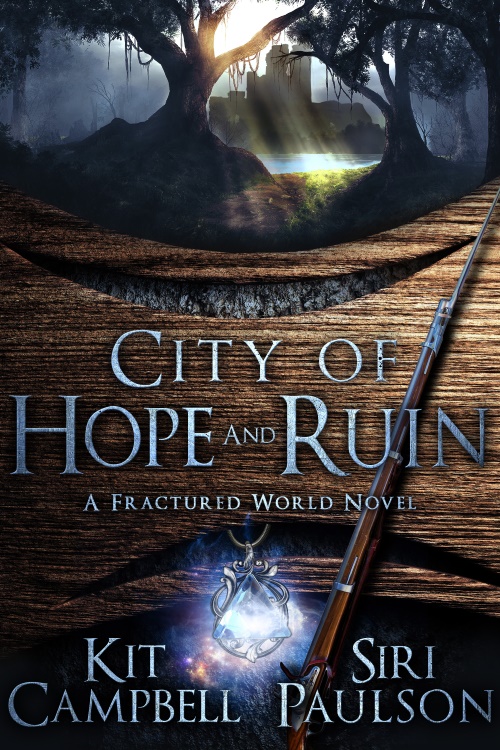
City of Hope and Ruin cover
AmazonKoboBarnes%20and%20NobleiBookscustom
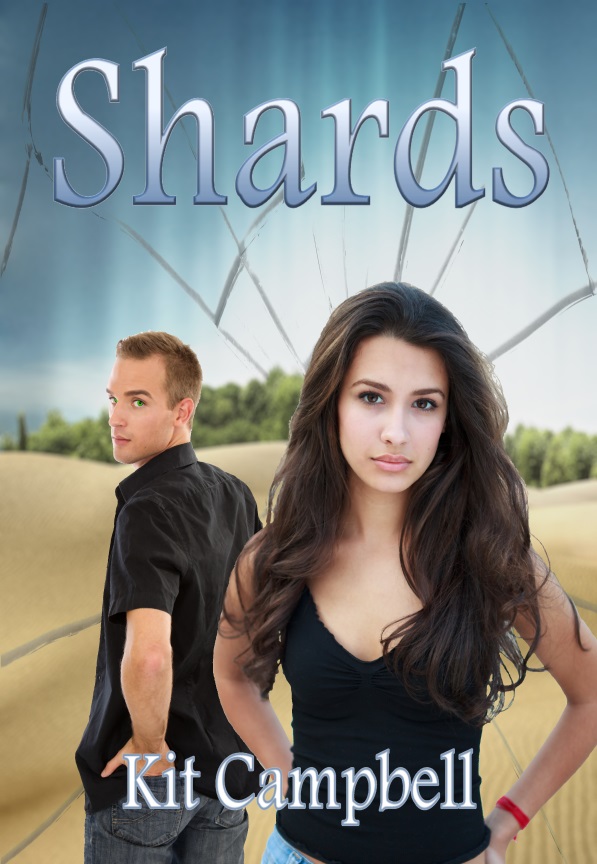
Shards cover
AmazonKoboSmashwordsBarnes%20and%20NobleiBookscustom
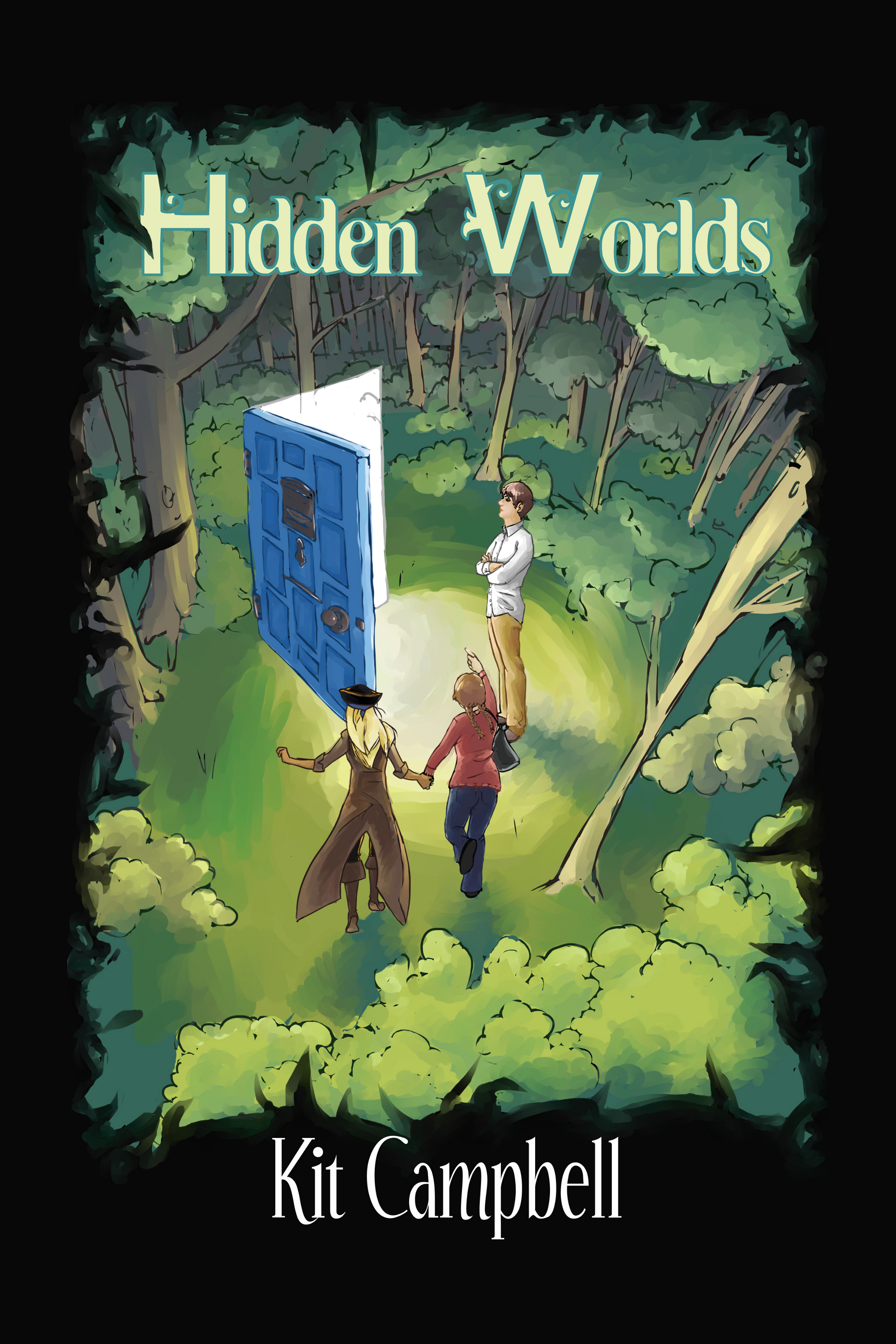
Hidden Worlds cover
AmazonKoboSmashwordsBarnes%20and%20NobleiBookscustom