Is It Really All Fear?

For storycraft on Tuesday night, we discussed the bane of so many writers: Writer’s Block.

Before the meeting, I trolled about on the Internet for a bit to help formulate points for discussion. And I came across this post, which states that all writer’s block has one cause: fear.

I brought this idea up to the group, and the unanimous response was disagreement. (And, actually, if read on to the rest of the post, I feel like even the original author somewhat contradicts his original statement.)

The thing is that there are different types of writer’s block. Sure, maybe some do stem from fear. Certainly when one is afraid of how something will be received, that can have a negative effect on the creation process. And previous failure or fear of failure can add to that. My group dubbed this particular type of writer’s block the Inner Critic block.

But all writer’s block?

I would argue that most writer’s block stems more from a planning standpoint than fear. You know, when you can’t figure out a logical way to get from point A to point B. When your characters can’t complete planned plot because they’ve changed through their arc and the actions no longer fit. When you’ve thrown so much at your characters that you can’t see how to get them out of the mess. Stuff like that.

What do you think, squiders? Is fear the cause of all creative block? I would say no, but let me know if you disagree.

We also discussed what types of writer’s block is most common for each of us. For me, at least recently, it’s been that I’ve had so many projects that need to worked on that I haven’t been managed to make much headway on any of them. We also talked about fixes–and mine is that I need to prioritize and focus on finishing one thing before moving on to another. What’s your most common block? What do you find helps?

The Rule of Three

Threes are important throughout human society, mythology, and literature. There’s something very ancient and instinctual about using threes, and you’ll find them everywhere. Storytelling is no different in this. One of the most common story structures is the three act structure, after all–a beginning, a middle, and an end. Even in school we’re taught that an essay needs three points to support it.

This can be used a ton of different ways–in the language itself, with repeating words or phrases; in plotting, with a certain event happening three different times, or an event building in three steps; and, perhaps my favorite, in characters.

An example of each:

Words:
“Veni, vidi, vici.” (I came, I saw, I conquered.)

Plotting:
Very common in fairy tales, such as in Rumpelstiltskin, both when the miller’s daughter weaves for three nights (and Rumpelstiltskin visits each night), and the three nights of name guessing.

Characters:
Again, common in nursery rhymes and fairy tales (The Three Little Pigs, Billy Goats Gruff, etc.), but can be found in a lot of popular culture, including a lot of my favorite stuff. In Harry Potter, you’ve got Harry, Hermione, and Ron. In Star Wars, you’ve got Luke, Leia, and Han. In Star Trek, you have Kirk, Spock, and Bones.

Since characters and character relationships have always been my favorite parts (both reading and writing) of stories, I tend to be most interested in this aspect of the Rule of Three. A story just seems stronger with three characters, doesn’t it? And sidekicks tend to come in three, too. Luna, Ginny, and Neville. Chewbacca, C3PO, and R2-D2. I think this somewhat stems from the idea of the triple deity–a single entity in three parts, with each part representing a certain aspect of the whole.

Anyway, it’s a neat thing to think about. Any examples you can think of that really work for you, Squiders?

Creating a Shared World

Shared worlds are an old and familiar subject to many people, I think. But for those who are unfamiliar with the concept, a shared world is a common world which many people write in. The Thieves World anthologies from the ’70s and ’80s are perhaps the most classic example of this, where dozens of fantasy authors used the same city and the same characters to tell stories. But another example of this would be universes like Star Trek or Star Wars, where authors tell stories in a familiar world.

You guys know I’m working on a co-written novel to be released next year. That in itself has proven interesting. But the hope is that this novel will also be the first in a shared world universe, with other authors coming in and expanding the world and the story as time goes on.

So, while our focus has been on providing an interesting and compelling story, there’s also been an emphasis on making everything broad enough. On leaving enough open avenues for someone else to take. On making sure there’s conflicts and characters and settings available. On making sure the world is rich enough and comprehensive enough that someone else will be able to see it–and not just see it, but create within in.

This has mostly been an issue with our ending. We love the world, we love the story–but we haven’t been able to pin down an ending, and we’ve reached the point where we need to know exactly where we’re going. There’s too many options, and we’ve got to pick one that wraps up this stage of our characters’ arcs while also leaving enough open for future stories.

So many interesting things could happen.

But which one provides the most interesting things?

Hopefully we’ll figure it out, and soon.

Have any favorite shared worlds, Squiders? Worked on some yourself? Have experiences to share?

Also, Burning Bright by the lovely KD Sarge is now out! You should pick up a copy.

Library Book Sale Finds: Murder at the Vicarage by Agatha Christie

Most of what we grabbed at the library book sales this summer were scifi and fantasy, but I love a good mystery and so I ended up with a fair amount of those as well. And I love Agatha Christie, but somehow seem to keep reading the same books over and over (accidentally).

This is the first of the Miss Marple novels, none of which I’ve managed to read before, though I have read the short story collections a few times. Or so I assume, because that’s what the front of the book said. Also, randomly, I went and saw Curtains at a local theater last Thursday night, and they referenced Murder at the Vicarage during it, which was a bit of an odd coincidence.

Title: Murder at the Vicarage
Author: Agatha Christie
Genre: Mystery
Publication Year:
1930

Pros: Very classic murder story with interesting twist
Cons: Feels a little old-school and dated at points, which is perhaps to be expected

Wikipedia tells me that it was not particularly well received upon publication, but I liked it.

Anyway! The book is from the vicar’s point of view, which I find is generally the case with the Miss Marple stories. I mean, not necessarily from the vicar’s, but not from Miss Marple’s. Which I guess is somewhat common–none of the Sherlock Holmes stories are from Holmes’ point of view. Obviously the idea is that it’s more interesting to be the outside observer. Anyway.

Universally despised Colonel Protheroe is murdered in the vicar’s study. Hence the title! And, of course, since everybody hates him literally anybody could have done it, though the vicar knows a secret about some of his parishioners which gives them a strong motive. And the book is perhaps more interesting from the vicar’s point of view, because he is at the center of the whole thing, and his insider knowledge as vicar gives him insights into people that others wouldn’t necessarily have. And so he spends more time wondering whether various people are capable of the crime, and it reads very authentically, as well as serving to throw the reader off.

The solution is a twist on a rather common mystery trope, which was a nice touch.

Miss Marple is probably one of the most recognizable mystery protagonists, so it was interesting to read the first book with her in it. As I said, I’ve previously read the short stories, and I used to watch the TV show (or was it merely part of PBS’ Mystery! series?) with my grandmother (a mystery enthusiast) back in the day, so it’s interesting to see the “beginning.” (Some of the short stories predate the novel.)

If you like mysteries, Christie, and/or Miss Marple, I’d give it a read. Why not? It is interesting to note that the character is not in its final stage as of yet, and that Miss Marple is different in later stories.

Goodnight Moon: Creepy Children’s Book or Creepiest Children’s Book?

Ah, squiders, we all know Goodnight Moon, right? It’s a classic from the ’40s or some such. Good night, room. Good night, moon. Good night, cow jumping over the moon. And so on.

OR SO YOU WOULD THINK.

We have my husband’s copy from when he was a kid that we have recently broken out to use again with the next generation. Such a sweet, calming book.

Until you get to this page:

Goodnight nobody
From Goodnight Moon by Margaret Wise Brown

Goodnight nobody. Because that’s not creepy.

It’s creepy in the way that small children are sometimes creepy, like when they stare at the corner and hold a conversation with no one. You know they’re probably just practicing their language skills, but there’s some small part of you that worries that there’s actually someone there that you can’t see–and they can.

The book then goes on until right near the end:

Goodnight noises everywhere
From Goodnight Moon by Margaret Wise Brown

Goodnight noises everywhere. Innocuous enough by itself, but by now I’m worried about nobody and I’ve started to wonder what sort of noises we’re talking about.

(My apologies for the crappy phone pics.)

Now, of course the story hasn’t changed since I was a kid, and I certainly had no recollection of these particular pages, but I think that (sadly) as an adult it’s easier to look at something and worry about what something means, whereas as a kid, you’re just like, “Goodnight nobody. Sure, of course, why not?” and it doesn’t faze you in the least.

Anyway! Happy forthcoming Halloween, squiders!

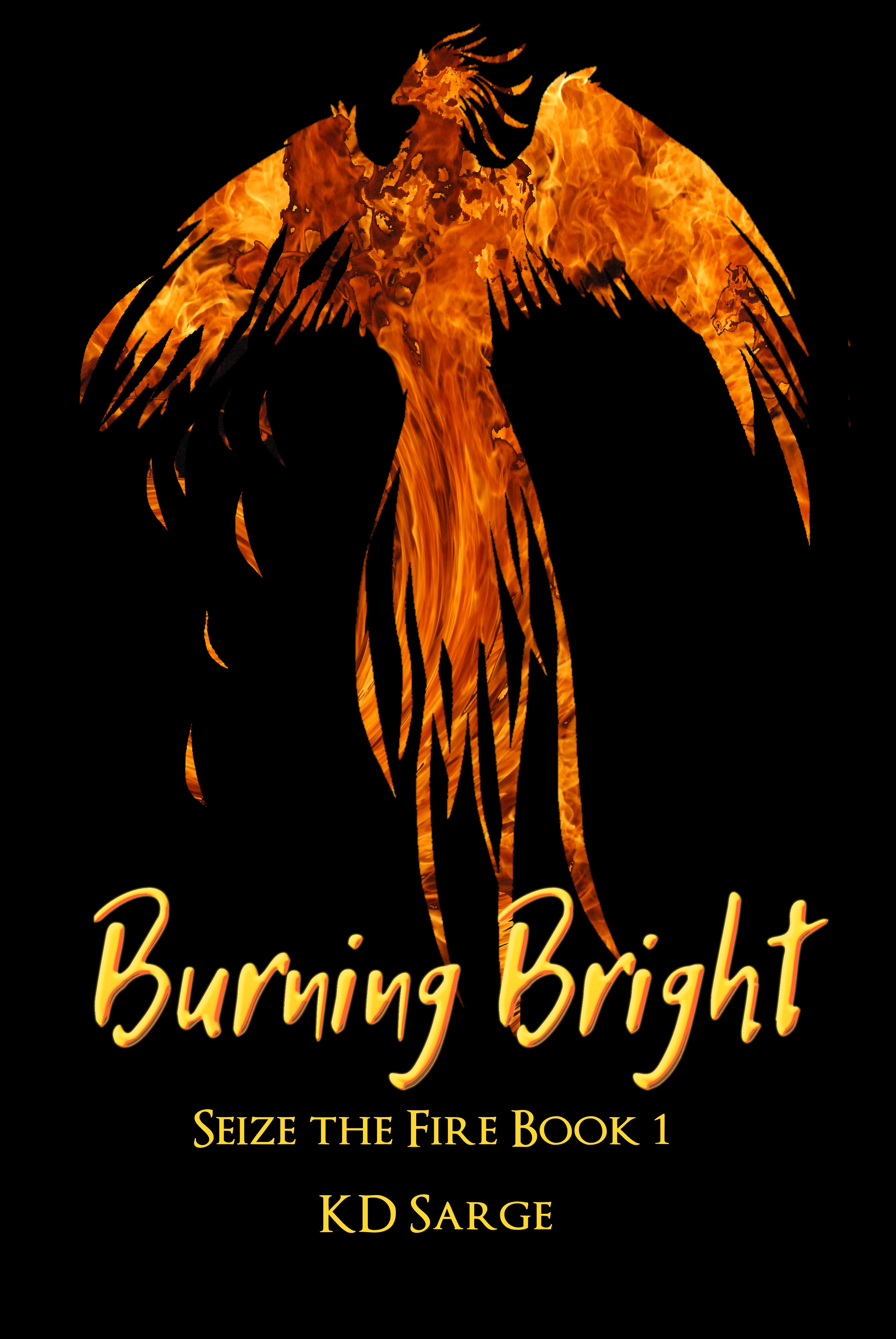
Cover Reveal: Burning Bright by KD Sarge

Good morning, Squiders! Today I am pleased to reveal the cover for KD’s newest book, being released through Turtleduck Press on Nov 1st! Burning Bright is the first in a fantasy trilogy.

Burning Bright Cover

To Keeper Apprentice Hiro Takai, Keepers are heroes, risking their lives to battle with sword and spell the demons that would devour all life. His master Eshan is one of the best—skilled beyond his years, and possessing exquisite control over his magic and emotions. Hiro is lucky to be harnessing his fire-magic under Eshan’s tutelage—and even luckier to be his lover.

But when Hiro wakes as a full Keeper after his Kindling ritual, everything is wrong. Something is in his mind, bringing him new and amazing power, but it’s not sane. Eshan is gone, slipped away on a dangerous mission leaving only a cryptic warning for Hiro to flee the Keepers—who are now debating if they should kill Hiro or just let him die.

No mage is more powerful, more knowledgeable, or more true than Eshan. Hiro knows his teacher can help—if Hiro can just find him. Find him, and save him. Before the Other in Hiro’s mind drives him mad, or tears his soul to shreds.

Mmmm…fire. Previews and more information can be found on Turtleduck Press’s website.

October, Why Have You Forsaken Me?

I love October, squiders. You know that. It’s autumn! My birthday! The start of the holidays (which I have heard appropriately referred to as Halloween, Nanowrimo, and Christmas)! I love October. I can break out the hot chocolate and snuggle under blankets and watch ridiculous movies.

But this year, October does not love me. Everyone in the family has been sick, some in that vague, lingering way where you’re not really sick, just tired. I’m sick and tired. Nobody’s naps line up in a useful manner. I did nothing for my birthday, though I did get some nice cake.

Things keep breaking in weird, inexplicable and time-consuming manners. Normal routines and chores go horribly awry. I feel like I’m being more scatterbrained than usual. Oh, and my website is still down. Super annoyed about that. How am I supposed to market/network/etc. without my website?

What the heck, October? I adore you, and this is how you repay me? Fie on you, October. Fie on you!

I just want to get work done! My novel draft, and some short stories that just need a little bit of editing, and a new collection to come out in December. And my other novel that is ready to start querying. Can’t you just let me get somewhere with some of them? One of them? Any of them?

I’m sorely tempted to just sleep for the rest of the month.

(Ask me how my day has gone, squiders. I dare you.)

The only good thing really happening is that I’m finally getting some reading back in (the beginning of the month ate that too). I finished Jay Kristoff’s Stormdancer yesterday which, once I got past the truly awful beginning, was pretty good. And I started Sarah J. Maas’ Throne of Glass which I’m really enjoying. Apparently I’m on a YA fantasy kick at the moment, but it may be all that’s keeping me sane.

What do you do, Squiders, when life just piles up on top of you?

The Book That Took Me 17 Years to Read

Ah, squiders. Have you ever had a book that you picked up, read part of, and then put down, through no fault of the book itself?

You told yourself you’d get back to it. But then time stretched on and on, and you forgot what happened in the part you read, and the book got stuffed some place random and you’re not sure where it is, or it was due back to the library, and for some reason it’s too much work to request it again, etc.

I had a book like that. I started it as an extra credit assignment during AP history my sophomore year of high school. I liked what I read for the assignment, and so figured I would read the whole book.

And didn’t.

Except now I have! Finally.

That book is Sophie’s World by Jostein Gaardner, with the appropriate subtitle of “A Novel About the History of Philosophy,” to which I would also add “Somewhat obsessed with meta-commentary on books and life in general.”

It has sat on my bookcase since sophomore history, staring at me, but I finally cracked it open and read the whole thing. And I wish I had read it as a teenager, honestly. I think I would have appreciated it more then. As an adult, I enjoyed the philosophy parts fine, but felt disconnected from the characters and somewhat underwhelmed with the meta take the book goes on starting about halfway through.

All that time just to not particularly like the book.

Is there a lesson to be taken away from this, squiders? Maybe. Something like: just finish the dang book within a reasonable time.

Ever had a book that took you forever to get through? Thoughts on Sophie’s World in general?

Obligatory Nanowrimo Post 2015

Ah, Squiders. It’s October. Best month of the year, of course, for many reasons, but it being October means it’s almost November. And November means Nanowrimo. And so October, these days, also means getting bombarded by Nano everywhere you look if you are a writer.

I do mean everywhere. Oy vey. And I apologize for adding to the madness, but I’ve had a bit of a headache and blog post topics are scarce at the moment.

(I got an email this morning from a woman who runs writing groups out of the local library about Nano prep, and she mentioned she’d done Nano five times, and I was like, “Well, I’ve done it eleven” and then I figured it was time to get off the internet.)

(If you’re interested in previous Nano adventures, feel free to search the “nanowrimo” tab here on the blog.)

(Also, the reason why there’s a year in the title is because I suspect I’ve already named a previous years’ entry this.)

(Help! I’m trapped in parenthetical phrases!)

Freedom!

Anyway. My Nano news this year is that I’m not doing Nano, so if you are sick of Nano stuff, after this entry you’ll be safe until next year.

Unlike 2013, where I waffled back and forth about whether or not I was going to participate since I had a book release on Dec 1 (2013 was the first year I missed since I started in 2003), I’m sure about this point. 2013 taught me that it was okay not to participate if it didn’t align with my current writing goals.

I’ve got a completed draft due to editors on Dec 1, so while I might feed off Nano to make sure things get done (I’ve got ~25K left to do, though I hope to have less by the time November hits), I’m not going to do it in any formal sort of way.

What about you, Squiders? Nano, yes or no? Sick of seeing it everywhere, or does that get you raring to go?

Writing Classes: One Size Does Not Fit All

Writing is an interesting thing to learn, because nobody’s processes are the same, nobody learns the same, nobody focuses on the same things while actually writing, and there’s no guarantee that something that was an epiphany for one person will even resonate with someone else.

When I was younger, I tried reading some writing books and gave up on the whole lot of them because they weren’t working for me. They either were telling me things I already understood, or the techniques they were suggesting seemed weird and arbitrary.

But as I’ve gotten older, I’ve realized that when you read a writing book or take a writing class, nothing is ever going to be a perfect fit, because everyone is different. So, what you do is take when does work for you, what does resonate, and you drop the stuff that doesn’t.

Sometimes there will be that near-perfect class that snaps something you weren’t quite getting into perspective. And sometimes there will be a class that rubs you wrong the whole way through and you only emerge with a couple of new tidbits that kind of work.

The important thing to remember is that just because a class doesn’t work for you doesn’t mean it won’t work for others. I just finished up a flash fiction course that a friend took and found very helpful, but the process rubbed me wrong the whole way through. Is it a bad class? No. It just didn’t work for me. Process thing. I still picked up a few things that will be good to think about in the future, even so.

So, how do you know if a class will work for you? Well–you don’t until you try. As time goes on, you’ll be able to tell what sorts of things work for you versus what doesn’t (for example, I hate writing to prompts just to write to prompts, and anything that promises “writing exercises” will pretty much make me want to scream) so you’ll be able to make some decisions based on class/book descriptions. If you know other writers with similar processes to yours, what worked for them might work for you. But otherwise–who knows? And something that might not sound great at first glance might be perfect.

What has worked for you? Any classes/books you found amazing? Any you found not so great?

Books by Kit Campbell

City of Hope and Ruin cover
AmazonKoboBarnes%20and%20NobleiBookscustom
Shards cover
AmazonKoboSmashwordsBarnes%20and%20NobleiBookscustom
Hidden Worlds cover
AmazonKoboSmashwordsBarnes%20and%20NobleiBookscustom